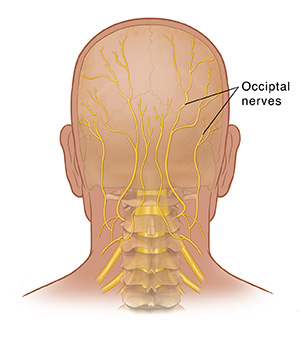
Occipital neuralgia is a type of intense headache. It occurs when the nerves that go from the top of your spine to your scalp (called the occipital nerves) are pinched or injured. This sends pain from the upper part of the neck to the back of the head and the scalp. This pain may be:
-
A sharp, shooting pain or an aching, throbbing pain.
-
On one or both sides of the head.
-
Behind an eye and ear.
-
In the forehead.
-
Set off by simple movement.
The pain may happen suddenly, caused by a pinched nerve in your neck or by an injury. Or it may be linked to another condition. Sometimes the exact cause isn’t known.
Occipital neuralgia can be hard to diagnose. That's because some symptoms are the same as migraines and other types of headaches. There isn’t a particular test that can be used for diagnosis. A physical and neurological exam will be done. Imaging tests may also be done, such as an MRI or a CT scan. In some cases, a diagnosis may be made if the pain is relieved by an injection of a local anesthetic and a steroid (called an occipital nerve block).
Many people feel better after home treatment, which focuses on easing pain. In some cases, surgery is needed to reduce pressure on the occipital nerves.
Home care
Here’s how to ease your pain at home:
-
Rest. Being in a quiet room may help.
-
Heat therapy. Using a heating pad or a warm compress on the area that hurts can help reduce muscle tightness and ease pain.
-
Massage. Gently massaging the base of your skull can help to ease tight neck muscles.
-
Physical therapy. A physical therapist can show you exercises and stretches to make the back and neck muscles stronger.
-
Medicines. Your health care provider may advise you to take over-the-counter anti-inflammatory medicines.
Other treatments may include:
-
Prescription medicines. Your provider may prescribe muscle relaxers, antidepressants, or anti-seizure medicines.
-
Occipital nerve block. The same injection of a local anesthetic and nerve block that’s used to diagnose occipital neuralgia can also be used to treat the pain.
-
Botulinum toxin injections. These can help by reducing nerve inflammation.
Follow-up care
Follow up with your health care provider, or as advised.
When to get medical advice
Contact your health care provider right away if home treatments aren’t working or your pain is getting worse. Your provider may recommend surgery to decrease pressure on the occipital nerves.