What is the ear?
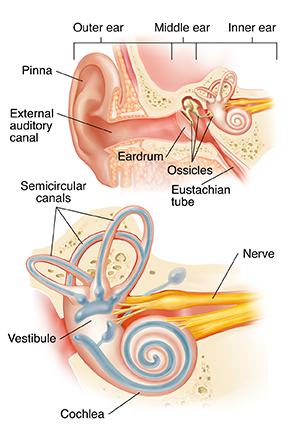
The ear is the organ of hearing and balance. The parts of the ear include:
-
External or outer ear, consisting of:
-
Pinna or auricle. This is the outside part of the ear.
-
External auditory canal or tube. This is the tube that connects the outer ear to the inside or middle ear.
-
-
Tympanic membrane (eardrum). The tympanic membrane divides the external ear from the middle ear.
-
Middle ear (tympanic cavity), consisting of:
-
Ossicles. Three small bones that are connected and send the sound waves to the inner ear. The bones are called:
-
Malleus
-
Incus
-
Stapes
-
-
Eustachian tube. A canal that links the middle ear with the back of the nose. The eustachian tube helps to equalize the pressure in the middle ear. Equalized pressure is needed for the correct transfer of sound waves. The eustachian tube is lined with mucous, just like the inside of the nose and throat.
-
-
Inner ear, consisting of:
-
Cochlea. This contains the nerves for hearing.
-
Vestibule. This contains receptors for balance.
-
Semicircular canals. This contains receptors for balance.
-
How do you hear?
Hearing starts with the outer ear. When a sound is made outside the outer ear, the sound waves, or vibrations, travel down the external auditory canal and strike the eardrum (tympanic membrane). The eardrum vibrates. The vibrations are then passed to 3 tiny bones in the middle ear called the ossicles. The ossicles amplify the sound. They send the sound waves to the inner ear and into the fluid-filled hearing organ (cochlea).
Once the sound waves reach the inner ear, they are converted into electrical impulses. The auditory nerve sends these impulses to the brain. The brain then translates these electrical impulses as sound.


