Definition

How You Hear

Choose a preferred language

Sound moves through the air like the ripples you see after throwing a stone into a pond. Your ears collect these waves of sound around you and send them to your brain. This is how the parts of your ear work so you can hear.


Three parts of your ear

Your ear is made up of the following parts: 

  • Your outer ear collects sound waves.

  • Sound waves enter the ear and hit the eardrum in your middle ear. Three tiny bones in the middle ear are set into motion.

  • This transfers sound waves to the fluid-filled inner ear. There, thousands of hair cells turn sound waves into nerve impulses. These impulses travel along nerves to your brain. When the impulses reach your brain, you perceive sound.
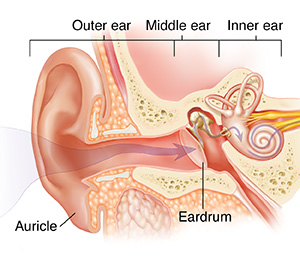
Cross section of ear showing outer, inner, and middle ear structures.


Damaged hair cells affect hearing

Hair cells move when incoming sound vibrates the inner ear fluid. The motion is turned into impulses that let you hear the sound.

Loud noise causes hair cells to move too much and can damage them. Flattened hair cells can't fully send nerve impulses to your brain. Once damaged, hair cells never recover.
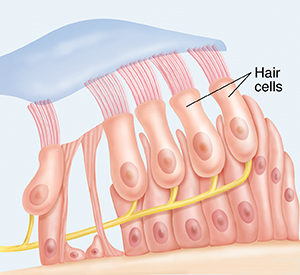

Hair cells in the cochlea.

© 2000-2026 The StayWell Company, LLC. All rights reserved. This information is not intended as a substitute for professional medical care. Always follow your healthcare professional's instructions.

Start your journey toward better health

Select a primary care physician who will deliver personal care, close to home.

Find a Doctor

Need Help?

Get the right care at the right time.

Learn More
Related Articles
Read article
Ear, Nose, and Throat
Ear, Nose, and Throat Facts

Read on for a detailed look at the parts that make up the ear, nose, and throat.

Read article
Ear, Nose, and Throat
Dizziness (Vertigo) and Balance Problems: Staying Safe

Falls or accidents can lead to pain, broken bones, a hospital stay, and a fear of future falls. Protect yourself and others by preparing for episodes. Simple steps can help increase your safety at home and wherever you go.

Read article
Ear, Nose, and Throat
Otolaryngology

Otolaryngology focuses on medical and surgical treatment for people who have disorders of the ear, nose, throat, and related structures.

Read article
Ear, Nose, and Throat
Hearing and Speech Communication Services and Devices

Read about the many devices available to help improve communication for people with speech or hearing problems.

