To diagnose a heart valve problem, your healthcare provider will first ask you questions about your family and health history. Certain tests may be done such as ultrasound of your heart (echocardiogram) and other imaging tests. These help diagnose your heart valve problem and rule out any other disease you may have.
Listening to your heart
A problem with a heart valve will usually cause the heart to make a noise. This noise is typically from turbulence of blood flow as it passes through the valve. Your provider can hear this noise, called a murmur, with a stethoscope. But you can have a heart murmur and not have valve disease or any other heart problem. Other tests can help confirm the diagnosis of valve disease. Heart murmurs are most often completely normal. But sometimes they can be a sign of heart disease.
Looking at your heart
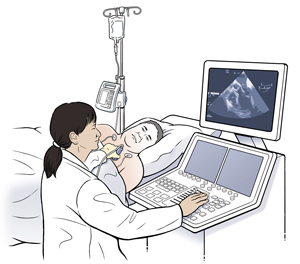
A transthoracic, or surface, echocardiogram (echo) is an ultrasound of the heart. It's called surface echocardiogram because the images are taken from the surface of the chest wall. A transthoracic echocardiogram is sometimes called by its abbreviation TTE. It's a simple, painless test that bounces harmless sound waves off the heart. These sound waves become images on a video screen. Your provider can then see a moving picture of your heart. This test shows how the valves work. It can confirm whether a valve is narrowed or leaking. It can also show the size of the heart's chambers and whether your heart muscle pumps normally. A special type of echo, called a transesophageal echo (TEE), may be done as well. This test can provide even more detailed information about your heart valves. But a TEE is somewhat more involved than a surface echo. It requires a probe to be passed into the tube leading from your mouth to your stomach (the esophagus). So a surface echo is often the first test done. Echo testing can help your provider watch changes in your heart over time.
Other tests
Your healthcare provider may order a chest X-ray for another look at your heart and lungs. You may have an electrocardiogram, a test that shows the rhythm of the heartbeat. You may have cardiac catheterization, an invasive test, to look inside the heart. This test helps measure the pressure in the chambers, checks for leaky valves, and looks for problems in the heart’s arteries. A cardiac MRI can also be done to evaluate the heart tissue, including valves.


