Pulse oximetry is a quick, easy, and painless test. It checks how much oxygen is in a baby’s blood. This test can help find some serious heart problems that babies can be born with. These are called critical congenital heart defects, or CCHD.
CCHD can cause low oxygen in the blood. These problems might not be seen right away. But they can be very dangerous if not found early. That’s why hospitals do this test on all newborns before they go home.
This test can't screen for all heart defects. Some of the main heart defects this test can help detect include:
-
Hypoplastic left heart syndrome (HLHS).
-
D-Transposition of the great arteries (d-TGA).
-
Tricuspid atresia (TA).
-
Total anomalous pulmonary venous return (TAPVR).
-
Tetralogy of Fallot (TOF).
-
Truncus arteriosus.
-
Pulmonary atresia with intact ventricular septum.
-
Coarctation of the aorta.
-
Double-outlet right ventricle (DORV).
Before the procedure
The results are most accurate when a baby is awake, warm, and quiet. Movement and crying can affect the accuracy of the test. Your baby may be wrapped in swaddling clothes to keep warm. You may be asked to hold your baby to help keep them calm.
Remove any socks or mittens your baby is wearing. A health care provider may then clean and dry your baby's skin.
During the procedure
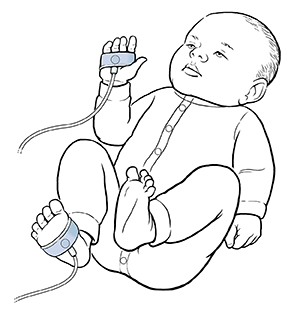
The provider will attach small sensors to your baby's right hand and one foot. This is usually a flexible, sticky strip placed on the skin. The sensors are connected to a wire that leads to a small device. The device measures the amount of oxygen in your baby's blood. Comparing the results from the hand and foot is an important part of the test.
After the procedure
The provider will remove the sensors. Any sticky adhesive left on the skin will be cleaned off.
If your baby passes the screening, no more tests are needed. If the reading is below a certain number or if there is a big difference between the hand and foot readings, your baby may need to repeat the test or have more tests. The additional tests may include an ultrasound of the heart (echocardiogram). Your child may also need to be seen by a cardiac specialist.
It's important to remember that this test won't find all heart defects. Sometimes, it may not find one of the defects it's intended to find. Because of this, your baby will also have a comprehensive history and physical exam. In addition, always make sure you keep all your baby's appointments with the doctor.
Featured in
Author: Wheeler, Brooke
© 2000-2026 The StayWell Company, LLC. All rights reserved. This information is not intended as a substitute for professional medical care. Always follow your healthcare professional's instructions.

