Recovery

Discharge Instructions: Taking Your Pulse

Choose a preferred language

Taking your pulse is a way to measure your heart rate. When you take your pulse, you're feeling the force of blood as it's pumped from your heart into other parts of your body. You may need to take your pulse regularly. Or you may just need to take it when you exercise or when you feel something is wrong.


 Step 1. Find your pulse
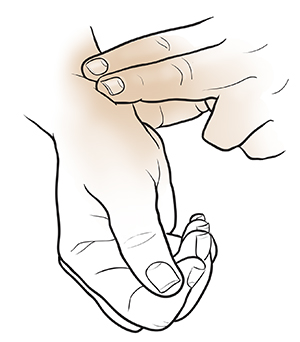
Hands showing how to take radial pulse.

  • With your first 2 fingers (index and middle fingers), press lightly on the inside of your wrist, just below the base of the thumb. You shouldn't be pressing on a bone. Don't use your thumb to do this.

  • The beats you feel are your pulse. If you can't find your pulse, try moving your fingers slightly to a new spot.


Step 2. Take your pulse

  • Count the beats you feel in your wrist as you watch the second hand on a clock. You may be told to count the beats for 30 seconds and then multiply that number by 2. Or you may be told to count for 1 full minute. Both methods will give you about the same result.

  • The number you get is your pulse measurement. It's measured in beats per minute (bpm). A normal pulse when you're at rest is between 60 and 100 bpm. The beats should be regular (evenly spaced).


 Step 3. Write down the results
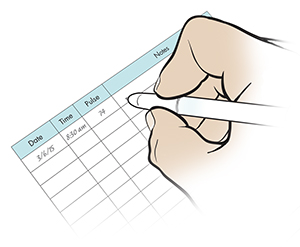
Hand writing in pulse log.

  • Write down your pulse each time you take it. You may be asked to bring the results with you each time you visit the health care provider.


© 2000-2026 The StayWell Company, LLC. All rights reserved. This information is not intended as a substitute for professional medical care. Always follow your healthcare professional's instructions.

Start your journey toward better health

Select a primary care physician who will deliver personal care, close to home.

Find a Doctor

We have more than 4,500 specialty care physicians in our network

We have you covered from head (neurosurgery) to toe (podiatry.) And everything in-between!

Find a Doctor

Need Help?

Get the right care at the right time.

Learn More
Related Articles
Read article
Heart Health
Discharge Instructions for Cardiomyopathy

Cardiomyopathy means that your heart is not functioning normally. It can make it more difficult to do things that may have been easy for you in the past.

Read article
Heart Health
Discharge Instructions for Low Blood Pressure (Hypotension)

Learn how to manage your low blood pressure at home.

Read article
Heart Health
Discharge Instructions: Taking Fast-Acting Nitroglycerin

Your health care provider prescribed nitroglycerin for you. Fast-acting nitroglycerin can stop an angina attack.

Read article
Heart Health
Discharge Instructions: Taking Long-Acting Nitroglycerin

Nitroglycerin relieves chest pain caused by a lack of blood to the heart (angina) by getting more oxygen-rich blood to your heart. Long-acting nitroglycerin helps prevent angina.