Treatment

Having Carotid Endarterectomy

Choose a preferred language

Carotid endarterectomy is a surgery to remove plaque from the carotid artery and improve blood flow to the brain. This surgery has a low risk for stroke (2% to 3%) in those with no pre-surgery symptoms. It often has a quick recovery with little pain. You may be asleep under general anesthesia. Or you may be awake with sedation and local anesthesia to control pain. Your surgeon will discuss which is a better option for you before your surgery.


How the endarterectomy is done
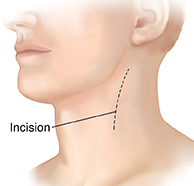
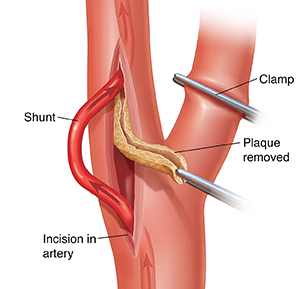
Three-quarter view of head and neck showing incision on neck for endarterectomy.Carotid artery showing incision with instrument removing plaque and shunt rerouting blood flow.

  1. Make the skin incision. The surgeon makes a cut (incision) in the skin over the carotid artery in the neck.

  2. Open the artery. The surgeon places clamps on the artery above and below the blockage. This temporarily stops blood flow. The brain receives blood from the carotid artery on the other side of your neck. The surgeon then makes an incision in the artery itself.

  3. Place the shunt. A shunt may be used to preserve blood flow to the brain during the procedure. After the shunt is in place, the clamps are removed from the internal carotid artery. In some cases a shunt is not needed because the brain is receiving enough blood through the carotid artery on the other side of your neck. 

  4. Remove plaque. The surgeon loosens plaque from the artery wall. The plaque is then removed, often in a single piece. The surgeon looks at the artery to confirm that all of the plaque has been removed.

  5. Close the incision. The surgeon closes the incision using either sutures or a patch. The clamps are then removed. Next, the skin incision is sutured closed. A tube or drain may be put in place to keep fluids from collecting around the area.

The surgery usually takes around 2 hours. But it may take longer depending on the anesthesia and your situation.


© 2000-2026 The StayWell Company, LLC. All rights reserved. This information is not intended as a substitute for professional medical care. Always follow your healthcare professional's instructions.

Start your journey toward better health

Select a primary care physician who will deliver personal care, close to home.

Find a Doctor

We have more than 4,500 specialty care physicians in our network

We have you covered from head (neurosurgery) to toe (podiatry.) And everything in-between!

Find a Doctor

Need Help?

Get the right care at the right time.

Learn More
Related Articles
Read article
Heart Health
Percutaneous Transcatheter Treatment of Deep Vein Thrombosis (DVT)

Percutaneous transcatheter treatment is one type of therapy for deep venous thrombosis (DVT). DVT is a blood clot that forms in a large vein deep in the body. It happens most often in a leg. The procedure uses a long thin tube to help remove the blood clot.

Read article
Heart Health
Preparing for Carotid Endarterectomy

Carotid endarterectomy removes plaque that has built up in your carotid artery. This helps reduce your risk for stroke. Be sure to follow all of the instructions you are given.

Read article
Heart Health
Peripheral Angioplasty

Peripheral angioplasty is a procedure that helps open blockages in peripheral arteries. These vessels carry blood to your lower body, legs, and arms.

Read article
Heart Health
Surgery for Varicose Veins

Information on surgery as a treatment choice for varicose veins.