Group B Streptococcus (GBS) is a gram-positive bacteria that lives in your stomach, intestines, rectum, and vagina. GBS is known to cause infections in newborns. Testing and treatment of group B strep during your pregnancy can help prevent your baby from becoming infected during birth. If your baby has complications from group B strep, they may need special treatments. Early treatment of GBS gives the best chance of a good outcome.
Testing
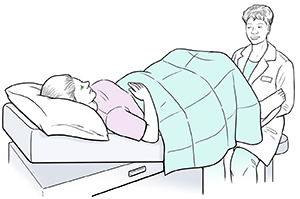
Testing for the bacteria is usually painless. This is most often during weeks 36 through 37 of pregnancy. For the test, your doctor uses cotton swabs to take samples from your vagina and anus. These samples are sent to the lab. Your doctor will get your test results about 2 days later. Results show if you have group B strep.
Treatment
If you test positive for GBS bacteria, you are at increased risk for passing the bacteria to your baby during birth. You'll be treated with IV antibiotics. These are given through a flexible tube (catheter) in a vein in your arm or hand. You may be treated for GBS even if you have not been tested but you have risk factors. They include:
-
Preterm labor and delivery (less than 37 weeks).
-
Maternal fever during labor (greater than 100.4 F or 38 C).
-
Prolonged rupture of membranes or "broken water" greater than 18 hours.
-
Previous child with early-onset GBS infection.
The treatment is not done until you start labor. This lets the medicine protect your baby during and after birth. Group B strep can come back after treatment. So IV antibiotics are started during labor and are given every 4 hours during labor until delivery. This should not affect the course of labor.
If group B strep is diagnosed in your urine, you'll be given medicine at that time to protect you from infections of the urinary tract. After the birth, your baby will be watched in the hospital for 24 to 48 hours. This is to make sure that they have not been infected. Your baby’s blood may also be tested.
When to get medical help
In newborns, most cases of group B strep infection are found before the mother and baby go home. But in very rare cases, a baby may get a group B strep infection after going home. This is called a late-onset infection. Contact your baby’s doctor right away if your baby:
-
Has a fever.
-
Won't feed.
-
Seems stressed or is fussy and can’t be calmed.
-
Has breathing trouble.
-
Has a very fast, very low, or irregular heart rate.
Featured in