Causes

Reasons for Pelvic Laparoscopy

Choose a preferred language

Pelvic laparoscopy lets your healthcare provider directly view the reproductive organs. They can see what’s causing problems. Problems may include pain, bleeding, abnormal growths, or trouble getting pregnant. Treatment may happen as part of the same procedure. It will depend on the cause of the problem. You'll discuss this with your healthcare provider before the procedure. Conditions often diagnosed and treated by laparoscopy are shown below.
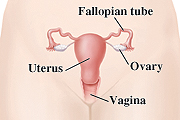
Female reproductive system including fallopian tube, ovary, uterus and vagina.

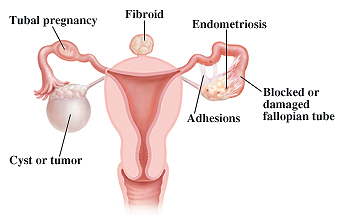
Female reproductive system showing examples fertility problems including tubal pregnancy, fibroid, endometriosis, adhesions, blocked or damaged fallopian tube, and cyst or tumor.

  • Tubal pregnancy. This occurs when an embryo implants in a fallopian tube. Untreated, the tube can burst (rupture) and bleed.

  • A fibroid (lump of uterine muscle tissue). This can cause pain, bleeding, and problems during pregnancy. It can also cause trouble getting pregnant.

  • Endometriosis (growth of uterine lining tissue outside the uterus). This can lead to pain, bleeding, and trouble getting pregnant.

  • A cyst (fluid-filled sac) or tumor (abnormal growth). These can form on the ovary or fallopian tube. They can cause pain and other health problems.

  • Adhesions (scar tissue). These can cause pain and trouble getting pregnant.

  • A blocked or damaged fallopian tube. This can cause trouble getting pregnant.

  • Sterilization. This will provide permanent birth control.

  • Infertility. This means difficulty getting pregnant.

  • Hysterectomy. This involves removing the uterus. It may be with or without removing the ovaries or fallopian tubes.

  • Pelvic organ prolapse. This is when the female organs drop into or out of the vagina.

  • Incontinence. This is when urine leaks unintentionally.

  • Some types of cancer.

Featured in

© 2000-2026 The StayWell Company, LLC. All rights reserved. This information is not intended as a substitute for professional medical care. Always follow your healthcare professional's instructions.

Start your journey toward better health

Select a primary care physician who will deliver personal care, close to home.

Find a Doctor

Need Help?

Get the right care at the right time.

Learn More
Related Articles
Read article
OB/GYN
Ovarian Cysts

A cyst is often a fluid-filled sac, like a small water balloon. Cysts are almost always harmless, and many go away on their own. Here are details about different types of cysts.

Read article
OB/GYN
How Reproductive Laparoscopy Is Done

Laparoscopy is a type of surgery. The doctor uses a long, thin tube with a camera to look inside your body.

Read article
OB/GYN
Pelvic Ultrasound

Pelvic ultrasound is an imaging test that uses sound waves to form pictures of your organs. It can help assess pain or other symptoms within your pelvis. In pregnant women, it is used to check the health of the unborn baby.

Read article
OB/GYN
Endometrial Biopsy

Endometrial biopsy is a procedure used to study the lining of the uterus. It is usually done in your health care provider's office.