Treatment

Broken Bones: A Note About Children

Choose a preferred language

A child’s bones heal the same way as an adult’s bones. But since a child’s bones are still growing, there are a few special concerns.


Growth plates

Growth plates are fragile groups of cells at the ends of a child’s long bones (such as the arms and legs). Growth plates make sure that the bones keep growing until they reach full length. If a growth plate is damaged in a fracture, the bone may not grow as it should. Fractures involving growth plates may need more follow-up visits to make sure the bones are growing correctly.
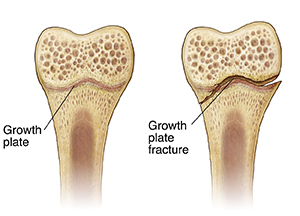
Cross-section of bone showing a growth plate and fractured growth plate


Remodeling

Remodeling happens more quickly in children than in adults. This means a child’s broken bone may not need to be lined up perfectly. As it heals, the bone straightens through remodeling. The younger a child is, the more likely the bones will grow straight with time.


© 2000-2026 The StayWell Company, LLC. All rights reserved. This information is not intended as a substitute for professional medical care. Always follow your healthcare professional's instructions.

Start your journey toward better health

Select a primary care physician who will deliver personal care, close to home.

Find a Doctor

We have more than 4,500 specialty care physicians in our network

We have you covered from head (neurosurgery) to toe (podiatry.) And everything in-between!

Find a Doctor

Need Help?

Get the right care at the right time.

Learn More
Related Articles
Read article
Brain Health
Altered Level of Consciousness (Child)

Level of consciousness (LOC) is a measure of a person’s ability to interact with other people and to react to things around them. Altered LOC is a medical emergency.

Read article
Urgent Care
Bone X-ray

A bone X-ray is a way to take pictures of bones. Low dose radiation (X-rays) is passed through the body, producing images of the bones on film.

Read article
Wellness
Disciplining Your Child at Any Age

Each child is different, but most children need to be given clear rules about behavior. Read on for some discipline tips by age group.

Read article
Genetic and Congenital Conditions
When Your Child Has Legg-Calvé-Perthes Disease

Your child has been diagnosed with Legg-Calvé-Perthes (LCP) disease. This is a problem with the head of the thighbone (femoral head). With LCP disease, the blood supply to the femoral head stops. Learn more about causes, symptoms, diagnosis, and treatment.