Treatment

Spinal Fusion: Posterior Lumbar

Choose a preferred language

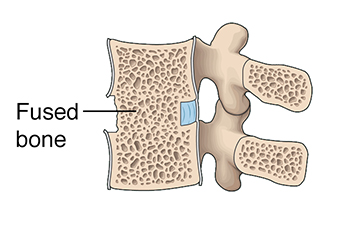
Fusing vertebrae in the lumbar spine may help ease lower back and leg pain. Spinal fusion is fusing two or more vertebrae together so they heal into a single, solid bone. The goal of spinal fusion is to reduce or eliminate painful motion and restore the stability of the spine. Posterior lumbar fusion is done through an incision in your back. Spacers and/or a bone graft are put between the vertebrae. Depending on how many vertebrae are fused, the surgery may take from 3 to 8 hours.
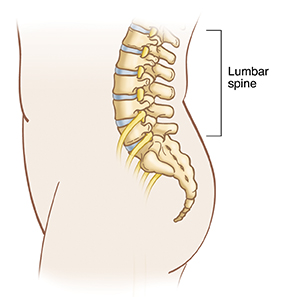
Side view of lumbar vertebrae.


Fusing the transverse processes

Fusion has several steps:

  • The bone graft is packed between the transverse processes (“wings”) on the sides of the vertebrae. This procedure is called posterolateral fusion.

  • To help keep your spine steady and promote fusion, extra support may be used such as titanium screws and rods. Sometimes, bone cement is added around the screws.

  • A wound drain is often placed in the wound and left in for a few days.

  • The incision is closed with stitches (sutures) or staples.
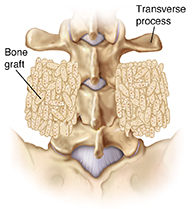
    Back view of lumbar vertebrae showing bone graft between transverse processes.


Fusing the disk space

This involves the following:

  • An incision is made in the middle of or on each side of your spine.

  • The disk between the vertebrae is removed. This procedure is known as posterior lumbar interbody fusion (PLIF).

  • A bone graft, a spacer (cage), or both are placed in the now-empty disk space between the vertebrae. In time, the graft or spacer and the bone will grow into a solid unit.

  • To help keep your spine steady and promote fusion, metal screws, and rods may be placed to provide extra support and promote healing. Sometimes, bone cement is added around the screws.

  • A wound drain is often placed in the wound and left in for a few days.

  • The incision is then closed with stitches or staples.
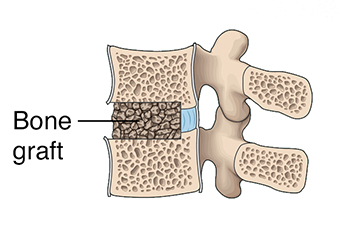
    Cross section of lumbar vertebrae showing bone graft between vertebrae.Cross section of lumbar vertebrae showing fused bone between vertebrae.

© 2000-2026 The StayWell Company, LLC. All rights reserved. This information is not intended as a substitute for professional medical care. Always follow your healthcare professional's instructions.

Start your journey toward better health

Select a primary care physician who will deliver personal care, close to home.

Find a Doctor

We have more than 4,500 specialty care physicians in our network

We have you covered from head (neurosurgery) to toe (podiatry.) And everything in-between!

Find a Doctor

Need Help?

Get the right care at the right time.

Learn More
Related Articles
Read article
Orthopedics
Foot Surgery: Flexible and Rigid Hammertoes

With hammertoes, one or more toes curl or bend abnormally. This can be caused by an inherited muscle problem, an abnormal bone length, or poor foot mechanics. There are many nonsurgical treatments for hammertoes, but if these are not effective, you may want to consider surgery.

Read article
Orthopedics
Treating Ankle Fractures

Treatment depends on where and how badly your ankle has been broken. A cast may be used to hold the bone in position for healing.

Read article
Orthopedics
Microdiskectomy

During a microdiscectomy, some disk is removed. In most cases, bone must first be removed to expose the damaged disk. The part of the disk outer wall and soft center that presses on the nerve can then be removed. There is usually enough disk remaining to cushion the vertebrae.

Read article
Orthopedics
Patella (Kneecap) Dislocation or Subluxation, Reduced

The kneecap is held in place by ligaments and tendons. If the kneecap is hit with a strong force, it can slide too far to the side of the knee joint, tearing these ligaments and tendons. This sliding is called subluxation or dislocation.