Treatment

Upper Body Exercises Before Surgery or Procedure: Help with Walker or Crutch Use

Choose a preferred language

Doing exercises before your surgery or procedure can help speed your recovery. These exercises build upper body strength. This can help you when you’re using a walker or crutches to get around after surgery. Your physical therapist or surgeon may advise you to use weights to make the exercises more effective. Follow your healthcare provider’s instructions.


Caution

Stop any exercise that causes sharp or increased knee pain, dizziness, shortness of breath, or chest pain.


Bicep curls
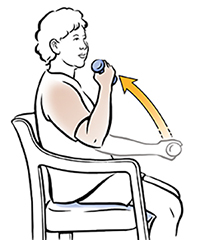
Seated woman doing biceps curls with hand weight.

  • Sit up straight. Keep your elbow close to your body and your wrist straight.

  • Bend your arm, moving your hand up to your shoulder, then lower slowly.

  • Repeat 10 to 15 times, or as advised.

  • Do a set with each arm.


Tricep curls

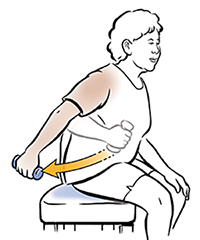
Seated woman doing triceps curls with hand weight.

  • Sit, leaning forward from the waist.

  • Bend your elbow so that your forearm is parallel to the floor. Then straighten your elbow as you extend your arm behind you.

  • Repeat 10 to 15 times, or as advised.

  • Do a set with each arm.


Seated press-ups
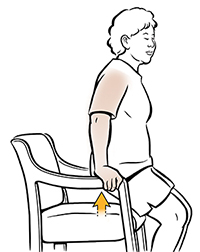
Woman doing seated press-ups in chair.

  • Sit in a sturdy chair with armrests.

  • With palms flat on the armrests, press down to lift your buttocks from the chair. Hold for 3 to 5 seconds.

  • Bend your elbows to slowly ease back down.

  • Repeat 10 to 15 times, or as advised.

Featured in

© 2000-2026 The StayWell Company, LLC. All rights reserved. This information is not intended as a substitute for professional medical care. Always follow your healthcare professional's instructions.

Start your journey toward better health

Select a primary care physician who will deliver personal care, close to home.

Find a Doctor

We have more than 4,500 specialty care physicians in our network

We have you covered from head (neurosurgery) to toe (podiatry.) And everything in-between!

Find a Doctor

Need Help?

Get the right care at the right time.

Learn More
Related Articles
Read article
Orthopedics
Foot Surgery: Flexible and Rigid Hammertoes

With hammertoes, one or more toes curl or bend abnormally. This can be caused by an inherited muscle problem, an abnormal bone length, or poor foot mechanics. There are many nonsurgical treatments for hammertoes, but if these are not effective, you may want to consider surgery.

Read article
Orthopedics
Understanding Achilles Tendon Repair Surgery

Achilles tendon repair surgery is a type of surgery to fix a damaged Achilles tendon.

Read article
Orthopedics
Kneecap Surgery: Removing Damaged Cartilage

Surgery may be used when pain severely limits your activities. Or it may be done when a rehab program or other nonsurgical treatments just are not helping enough. Some procedures may be done using arthroscopy. This method uses tiny incisions and special instruments to look and work inside the knee joint. Other procedures need open surgery.

Read article
Orthopedics
Foot Surgery: Curled Fifth Toe

A curled fifth toe is most often inherited. When the fifth toe curls inward, it moves under the next toe. Then the nail of the curled toe starts to face outward. As a result, you may bear weight on the side of your toe instead of the bottom. This can cause corns and painful nails. There are many nonsurgical treatments available. But if these are not effective, surgery is a choice.