The biceps is the muscle on the front of the upper arm. Biceps tendons are connective tissue that attach this muscle to the bones of the shoulder and arm. Overuse or a sudden injury to tendons can cause pain. Distal biceps tendonitis, also called lower biceps tendonitis, is the inflammation of the lower part of the biceps tendon, near the elbow. Distal refers to the elbow end of the biceps because it's farther away from the center of the body.
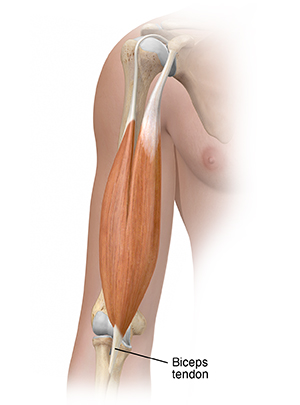
Causes of biceps tendonitis
The biceps tendons can be damaged by:
-
Lifting heavy weights.
-
Using your arms more than usual, such as training harder for a sport or doing a task that requires a lot of lifting.
-
Low-level stress on the tendons over time, especially repetitive motions.
-
Other injuries to the arm or elbow.
Symptoms of biceps tendonitis
These may include:
-
Pain or tenderness at the front of the elbow.
-
Pain that gets worse when bending the elbow or rotating the forearm.
-
Arm weakness.
-
A crackling sound or grating feeling when moving the elbow.
Treatment for biceps tendonitis
This problem often gets better with rest and medicines. Treatments aim to reduce pain and help the tendon heal. Possible treatments include:
-
Avoiding actions that make the pain worse to allow the elbow to rest.
-
Using over-the-counter or prescription medicine to help relieve pain and swelling. NSAIDs (nonsteroidal anti-inflammatory drugs) are the most common medicines used. Medicines may be prescribed or bought over the counter. They may be given as pills or applied on the skin as a gel, cream, or patch.
-
Applying cold packs to help relieve pain and swelling.
-
Trying stretches and other exercises to help with range of motion and strength.
-
A steroid injection into the affected area to reduce inflammation and pain.
If these treatments don’t do enough to relieve symptoms, physical therapy may be helpful. For severe symptoms, or if the tendon ruptures, your health care provider may advise surgery to repair the tendon.
When to call your doctor
Contact your health care provider right away if you have:
-
A fever of 100.4°F (38°C) or higher, or as advised by your provider.
-
Chills.
-
Symptoms that don’t get better, or get worse.
-
New symptoms.
-
Bruising or swelling of the injured arm.
-
A bulging appearance of the biceps muscle on the injured arm.
Author: Freed. Becca
© 2000-2026 The StayWell Company, LLC. All rights reserved. This information is not intended as a substitute for professional medical care. Always follow your healthcare professional's instructions.