Types

Understanding Hip Fractures

Choose a preferred language

The hip is one of the largest weight-bearing joints in the body. It’s also a common place for a fracture after a fall—especially in older people. Hip fractures are even more likely in people with osteoporosis, a disease that leads to weakened bones.


A healthy hip

The hip is a ball-and-socket joint where the thighbone (femur) joins the pelvis. When the hip is healthy, you can walk, turn, and move without pain. The head or ball of the femur fits into a socket in the pelvis. The ball and socket are each covered with smooth cartilage. This allows the ball to glide easily in the socket. Blood vessels supply oxygen and nutrients to keep the hip joint healthy.
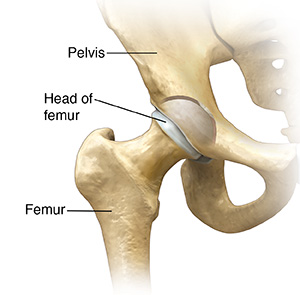
Front view of hip joint.


A fractured hip

The hip can fracture in many places. Most often, the fracture occurs in the upper part of the femur. In rare cases, you can also have more than one type of fracture at a time:

  • Transcervical fracture. A break across the neck of the femur, just under the ball. This type of fracture can interrupt blood flow to the joint.

  • Intertrochanteric fracture. A break down through the top of the femur.

  • Subtrochanteric fracture. A break across the upper shaft of the femur.
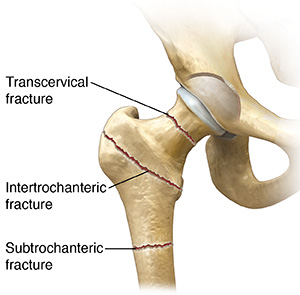
Front view of hip joint showing three types of hip fractures.

© 2000-2026 The StayWell Company, LLC. All rights reserved. This information is not intended as a substitute for professional medical care. Always follow your healthcare professional's instructions.

Start your journey toward better health

Select a primary care physician who will deliver personal care, close to home.

Find a Doctor

We have more than 4,500 specialty care physicians in our network

We have you covered from head (neurosurgery) to toe (podiatry.) And everything in-between!

Find a Doctor

Need Help?

Get the right care at the right time.

Learn More
Related Articles
Read article
Orthopedics
Knee Sprain of the Collateral Ligaments

You have a knee sprain. A sprain is a tearing of a ligament. Learn how to take care of a knee sprain at home.

Read article
Orthopedics
Back Spasm (No Trauma)

Learn about back muscle spasms and how to care for yourself when they occur.

Read article
Orthopedics
Coccyx or Sacrum Bruise (Contusion)

A contusion of the coccyx or sacrum causes swelling and some bleeding under the skin. This injury generally takes a few weeks to heal. Read on for details about how to care for yourself.

Read article
Orthopedics
Understanding Osgood-Schlatter Disease

Osgood-Schlatter disease is a painful knee problem that can happen in active young people. It almost always gets better with rest and simple treatment.