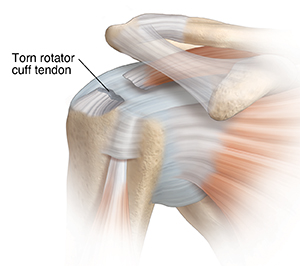
The rotator cuff is a group of four muscles and their tendons in the shoulder. The muscles are located in the front, back, and top of the shoulder joint. They each have a strong band of tissue (tendon) that attaches to the top of the upper arm bone. This helps keep the arm bone firmly in place in the socket of the shoulder joint. The muscles and tendons of the rotator cuff also help the shoulder joint with certain movements. These include reaching the arm over the head and rotating the arm.
Any one of the rotator cuff tendons can fray or tear from causes such as injury and overuse. A tear may be partial or complete. With a partial tear, some of the tendon is still intact. With a complete tear, the tendon is fully torn. Both types can cause pain and weakness. Arm and shoulder movement also may be limited. A rotator cuff tear often needs treatment to heal properly.
Causes of a rotator cuff tendon tear
Causes can include:
-
Wear and tear of the tendons from normal use over time or from aging.
-
Overuse of the tendons from sports or work activities, especially those that involve repeated overhead movements.
-
Injury to the tendons from a fall or other accident.
Symptoms of a rotator cuff tendon tear
Some people with a rotator cuff tendon tear have few or no symptoms. Others may have symptoms that range from mild to severe. Possible symptoms include:
-
Pain in your shoulder, which may be worse with overhead movements or at night from lying on the affected side.
-
Weakness in your arm and shoulder.
-
Trouble lifting your arm or rotating it.
-
Clicking or crackling sounds when moving or using your arm and shoulder in certain positions.
Treating a rotator cuff tendon tear
Treatment for a rotator cuff tendon tear depends on several factors. These include how severe the tear is, your age, any other health conditions you may have, and your symptoms. Treatment may include:
-
Resting your arm and shoulder. This involves limiting certain movements, such as reaching above your head or lifting up your arm. These can slow healing and worsen symptoms. You may also need to avoid certain sports and types of work for a time.
-
Cold packs or heat packs. These help reduce pain and swelling.
-
Prescription or over-the-counter medicines. These help reduce pain and swelling. NSAIDs (nonsteroidal anti-inflammatory drugs) are the most common medicines used. They may be taken as pills. Or they may be put on the skin as a gel, cream, or patch.
-
Injections of medicine into your shoulder. These help relieve pain and swelling for a time. The medicine is usually a corticosteroid. This is a strong medicine that helps ease inflammation.
-
Physical therapy and exercises. These help improve strength, flexibility, and range of motion in your arm and shoulder.
-
Surgery. Surgery may be needed if your tendon is completely torn or if other treatments don’t relieve your symptoms. Different options are available. In many cases, the damaged tendon is repaired and reattached to your arm bone.
Possible complications
-
If a partial tear isn’t given time to heal, it may get larger or tear completely. You may then need more intensive treatment.
-
Even with treatment, a partial or complete tear may sometimes have trouble healing. The problem may become long-term (chronic). This can cause ongoing pain, weakness, and limited movement of your arm and shoulder.
When to call your health care provider
Call your health care provider right away if you have any of these:
-
Fever of 100.4°F (38°C) or higher, or as advised by your health care provider
-
Chills
-
Symptoms that don’t get better with treatment, or get worse
-
Redness, warmth, swelling, bleeding, or drainage at the incision site after surgery
-
New symptoms
Author: Yang, Sue
© 2000-2026 The StayWell Company, LLC. All rights reserved. This information is not intended as a substitute for professional medical care. Always follow your healthcare professional's instructions.