Turf toe is a sprain of the largest joint of the big toe. It happens when the toe bends up too far. This can happen when pushing off the foot to run or from injury.
Turf toe became more common when football players began playing on artificial turf instead of grass. Artificial turf is harder than grass. It’s a common injury for athletes who play football or other sports on artificial turf. But it can occur in a wide variety of sports and activities.
Your big toe joints
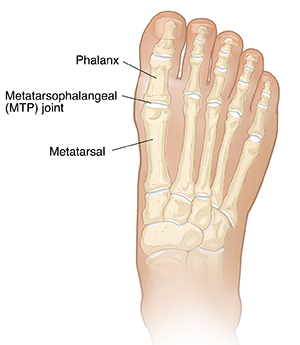
Your big toe has two joints. The metatarsophalangeal (MTP) joint is the largest. This is where the first long bone of the foot (metatarsal) connects with the first bone of the toe (phalanx). Strong tissues surround this joint and hold it in place. These include:
-
Fibrous tissues under the MTP joint.
-
Ligaments on the sides of your big toe.
-
A tendon that runs under the first metatarsal bone.
-
Two tiny bones that help this tendon move.
What causes turf toe?
Turf toe most often happens when the toe is on the ground and the heel is raised. Turf toe can then occur if you push off with your foot to run. It can cause your toe to bend up at an angle more than it should. You are more likely to get turf toe if you do athletic activities on artificial turf. You also may be more likely to get turf toe if you use a soft, flexible shoe instead of a shoe that gives more support to the front of your foot.
Symptoms of turf toe
Symptoms of turf toe may vary but can include:
-
Pain at the front of your foot, especially to the touch.
-
Swelling at the front of your foot.
-
Bruising at the front of your foot.
-
Inability to bend your big toe down.
-
A loose toe joint that isn’t lined up (dislocated).
-
Inability to put weight on your toe.
Diagnosing turf toe
Your doctor will ask about your health history and your symptoms. They will ask how you injured your foot. They will examine your foot. This is to look for bruising, swelling, and range of motion. If this is painful, your doctor may inject your foot with a numbing medicine.
You may need imaging tests. These are done to look at the bones and other tissues inside the foot. You may have tests such as:
-
X-rays. These use a small amount of radiation to create images of the inside of the body.
-
MRI. This test uses large magnets and a computer to create images of the inside of the body.