Management

Kidney Disease: Understanding Fluids

Choose a preferred language

Healthy kidneys balance the amount of fluid that enters and leaves the body. If your kidneys can't maintain this fluid balance, you may need to limit your fluid intake. Always talk with your healthcare provider and ask how many ounces of fluid you can have every 24 hours. For accuracy, it's helpful to use a certain glass or mug and measure how much fluid it holds. Some glasses and mugs may look the same size. But they can hold different amounts of fluid. The information below can help.
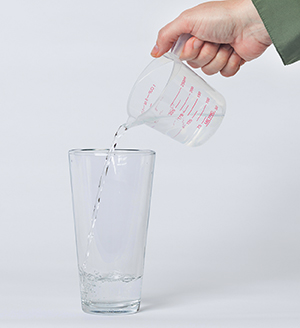
Hand pouring water from measuring cup into drinking glass.


What counts as a fluid?

Fluids are foods that are liquid at room temperature. Foods that count toward your fluid intake include:

  • Water for drinking and taking medicines.

  • Ice cubes and ice chips.

  • Coffee and tea.

  • Sodas.

  • Milk, cream, and liquid creamer.

  • Juices, both fruit and vegetable.

  • Soups.

  • Flavored ice pops.

  • Ice cream, sherbets, and sorbets.

  • Gelatin dessert, such as Jell-O.


Figuring fluid amounts

Fluids can be measured in different ways. The chart below can help you convert among units of measure. For ease of use, some numbers have been rounded off.

1 liter

4.2 cups

34 ounces

1,000 ml

1 quart

4 cups

32 ounces

1,000 ml

1 pint

2 cups

16 ounces

500 ml

1/2 pint

1 cup

8 ounces

250 ml

1/2 cup

4 ounces

120 ml

1/3 cup

3 ounces

80 ml

1/4 cup

2 ounces

60 ml

2 tbsp

1/8 cup

1 ounce

30 ml

© 2000-2026 The StayWell Company, LLC. All rights reserved. This information is not intended as a substitute for professional medical care. Always follow your healthcare professional's instructions.

Start your journey toward better health

Select a primary care physician who will deliver personal care, close to home.

Find a Doctor

We have more than 4,500 specialty care physicians in our network

We have you covered from head (neurosurgery) to toe (podiatry.) And everything in-between!

Find a Doctor

Need Help?

Get the right care at the right time.

Learn More
Related Articles
Read article
Urology
Chronic Kidney Disease (CKD)

When the kidneys don't work normally and waste products start to build up in the blood, this is called chronic kidney disease (CKD). Read on to learn how to care for yourself at home.

Read article
Urology
Urine Strainer

A urine strainer is used to collect a kidney stone from the urine stream. Learn how to use a urine strainer.

Read article
Heart Health
Hemodialysis Access Bleeding

You have a hemodialysis access in your arm, either an arteriovenous (AV) fistula or an artery to vein graft. It has been bleeding. Blood needs to flow freely through the fistula or graft. As part of your treatment, you are also taking medication that thins your blood. This makes you bleed more easily. It is important to stop your fistula or graft from bleeding as soon as possible.

Read article
Urology
Foley Catheter Care

A Foley catheter is a flexible plastic or rubber tube that is placed through the urethra (opening where urine comes out) and into the bladder. This helps drain urine from the bladder. There is a small balloon on the end of the tube that is inflated after insertion. This keeps the catheter from sliding out of the bladder.


