Peritoneal dialysis (PD) is a way to cleanse the blood when your kidneys aren't working as well as they should. This procedure helps remove excess fluid and waste from the blood.
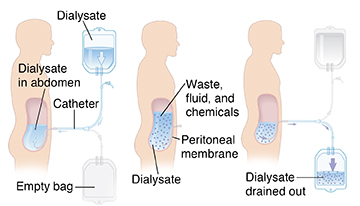
It uses the lining of your abdomen, called the peritoneal membrane, and a special solution (dialysate). The solution needs to be changed several times a day. This can be done as part of your home or work routine. Or it can be done at night by a machine. Dialysate is put inside your belly (abdomen) through a plastic tube (catheter). This catheter is surgically placed into your abdomen. It takes the catheter site 2 to 4 weeks to heal before you can use it. Your health care provider may tell you to have this catheter put in place before your kidneys fail completely.
PD is not for everyone. Certain conditions, such as morbid obesity or multiple abdominal surgeries, may mean that PD can't be used. Also, PD training must be successfully completed, or a trained helper must be available. The training allows you and/or your caregiver to perform dialysis at home on your own. Your health care provider will explain the options that are right for your situation.
How PD works
The abdomen is filled with dialysate through the catheter and allowed to remain (dwell) for 4 to 6 hours. The membrane and dialysate then work to clean the blood. The peritoneal membrane acts as a filter for this process. The dialysate needs to be changed every few hours. This is called an exchange.
The dialysate is a liquid that pulls out excess fluid and waste from your body, which are eliminated during exchange.
Your experience
-
You can do PD at home, work, or wherever is convenient.
-
A nurse or technician will teach you how to do PD exchanges and care for the PD tube.
-
You have an increased risk of infection in your abdomen (peritonitis). It's very important to carefully follow all instructions to prevent infection.
-
Put on a surgical mask and wash your hands thoroughly with soap and warm water before you touch the catheter.
-
Clean the catheter area as advised by your health care provider.
-
Keep your catheter dry. Avoid swimming or using hot tubs.
-
Do the exchange in a clean and dry place.
-
-
You will need to weigh yourself every day to make sure you don't have too much fluid in your body.
-
You will need to follow a special diet.
There are two ways to do exchanges:
-
Continuous ambulatory peritoneal dialysis (CAPD). With this, you do your own exchanges 3 to 5 times a day, each with a dwell time of about 4 to 6 hours. (You can have a longer dwell time overnight.) Each exchange takes about 30 to 40 minutes.
-
Cyclic peritoneal dialysis (CCPD). This uses a machine called a cycler. The cycler does most of your exchanges at night while you sleep. You have a long dwell time during the day.
When to get medical advice
Contact your health care provider right away if you have:
-
A fever of 100.4°F (38°C) or higher, or as directed by your provider.
-
Chills.
-
Dialysate that is cloudy or bloody when it drains from your body.
-
Pain in your abdomen or around your catheter.
-
Skin around your catheter that is warm or red or has drainage.
-
Blocked flow into or out of your catheter.
-
A part of your belly that appears to be bulging (hernia).
-
New symptoms.