Types

Hydrocele in the Newborn

Choose a preferred language

Hydrocele is a collection of fluid in the scrotum surrounding the testicle. This sometimes happens to baby boys.

This could happen because the baby’s abdominal wall wasn’t fully developed at birth. Or there may be an opening between the abdomen and scrotum that didn’t close as it should have after birth.
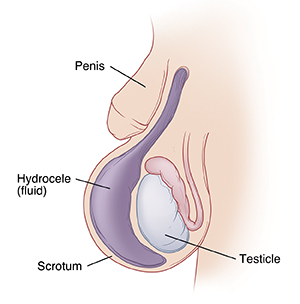
Closeup of penis and scrotum showing testicle inside surrounded by large sac of fluid (hydrocele).


When is a hydrocele treated?

Hydrocele often goes away by itself, as the body slowly absorbs the abdominal fluid. But in some cases, surgery is needed. The hydrocele will be treated if:

  • The amount of fluid increases, making the scrotum large and firm.

  • The hydrocele becomes infected, painful, or uncomfortable.

  • The fluid isn’t absorbed within the baby’s first year of life.

  • The baby also has a loop of bowel (a hernia) extending into the same area.


What are the long-term effects?

After the hydrocele goes away or is treated, lasting problems are rare.


Signs of a problem

If you see any of these signs, contact your baby’s health care provider or get medical care right away:

  • The hydrocele gets bigger or red.

  • Your baby cries more than normal and can’t be soothed.

  • Your baby cries or fusses when you touch the hydrocele.

Featured in

© 2000-2026 The StayWell Company, LLC. All rights reserved. This information is not intended as a substitute for professional medical care. Always follow your healthcare professional's instructions.

Start your journey toward better health

Select a primary care physician who will deliver personal care, close to home.

Find a Doctor

We have more than 4,500 specialty care physicians in our network

We have you covered from head (neurosurgery) to toe (podiatry.) And everything in-between!

Find a Doctor

Need Help?

Get the right care at the right time.

Learn More
Related Articles
Read article
Urology
Prune Belly Syndrome in Children

A child with prune belly syndrome often can't fully empty their bladder. This can cause serious bladder, ureter, and kidney problems.

Read article
Urology
Posterior Urethral Valves in Children

Posterior urethral valves are a problem with the urethra in a boy. The valves partly block urine flow because not enough urine can get through them to leave the body. This can harm the urethra, bladder, ureters, and kidneys.

Read article
Urology
Hydrocele (Type Not Specified)

Read on to learn how to care for your baby when they have a hydrocele.

Read article
Urology
Male Bladder Infection (Child)

Read on for details about caring for a male child with a bladder infection.

