Symptoms

Normal Breathing During Sleep

Choose a preferred language

When you breathe, air travels through passages in your nose and throat to reach your lungs. When these air passages are wide enough to let air flow freely, you breathe normally.


Nasal structures

The septum is the wall that divides the left half of the nose from the right half. Turbinates are ridges in the nasal passage. They help warm and moisturize air as it flows through the nose.
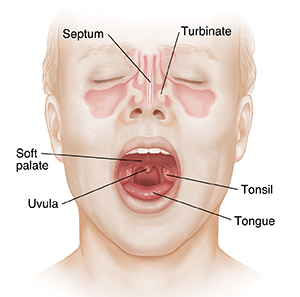
Front of face showing septum, turbinate, and open mouth with tonsil, tongue, uvula, and soft palate.


Throat structures

Air flows past soft, flexible structures where the mouth meets the throat. These structures are the soft palate, uvula, tonsils, and back of the tongue. Throat muscles hold these structures in place. While you sleep, the throat muscles relax a bit. But they normally stay tight enough to keep the airway open.
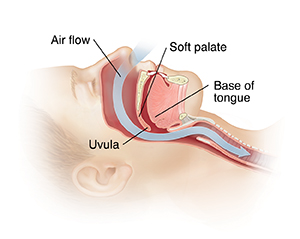
Side view of head with arrow showing path of air through nasal passages into trachea.

© 2000-2026 The StayWell Company, LLC. All rights reserved. This information is not intended as a substitute for professional medical care. Always follow your healthcare professional's instructions.



Start your journey toward better health

Select a primary care physician who will deliver personal care, close to home.

Find a Doctor

Need Help?

Get the right care at the right time.

Learn More
Related Articles
Read article
Wellness
Insomnia

Insomnia is repeated difficulty going to sleep or staying asleep, or both. Whether you have insomnia is not defined by a specific amount of sleep. Different people need different amounts of sleep, and you may need more or less sleep at different times of your life.

Read article
Brain Health
Obstructive Sleep Apnea

Obstructive sleep apnea occurs when your breathing stops briefly during sleep. This can occur when something is blocking your airway. The stopped breathing can occur many times a night causing snoring, and daytime fatigue.

Read article
Brain Health
Primary Sleep Disorders: Dyssomnias

A detailed look at dyssomnia sleep disorders. These sleep disorders are caused by another health problem.

Read article
Wellness
Understanding Restless Legs Syndrome

Restless legs syndrome is a creepy, crawly feeling in the legs. Medications and lifestyle changes can help.