Treatment

Small-Incision Cataract Surgery: Implanting the New Lens

Choose a preferred language


Once your old cloudy lens has been removed, your surgeon slips the new clear lens (IOL or intraocular lens) in through the incision. The IOL is then placed in the capsule that held your old lens. With the new lens in place, your surgeon is ready to close the incision. Some incisions may be closed with stitches. Others are self-sealing. That means they will stay closed on their own without stitches. The IOL does nearly the same thing that your old lens did before it became cloudy. It focuses light, letting you see sharp images and vivid colors. The IOL normally lasts a lifetime.
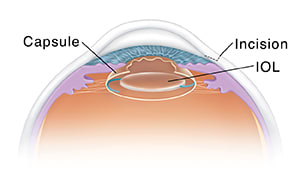
Cross section of eye showing intraocular lens implant.


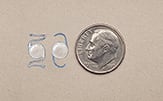
How small is an IOL?

Intraocular lenses next to a dime for size comparison.

Featured in

Online Medical Reviewer: Chris Haupert MD

Online Medical Reviewer: Raymond Kent Turley BSN MSN RN

Online Medical Reviewer: Rita Sather RN

Date Last Reviewed: 09/01/2025

© 2000-2026 The StayWell Company, LLC. All rights reserved. This information is not intended as a substitute for professional medical care. Always follow your healthcare professional's instructions.



Start your journey toward better health

Select a primary care physician who will deliver personal care, close to home.

Find a Doctor

Need Help?

Get the right care at the right time.

Learn More
Related Articles
Read article
Eye Care
Refractive Surgery: Phakic IOLs

Phakic intraocular lenses (PIOLs) can help you see better without glasses or corrective lenses. Here's what you can expect.

Read article
Eye Care
Small-Incision Cataract Surgery: Removing the Old Lens

You may be surprised by how little time small-incision cataract surgery takes.

Read article
Eye Care
Cataract Surgery

A detailed look at cataract surgery, including possible risks, what to expect during the procedure, and recovery afterward.

Read article
Eye Care
Refractive Surgery: Is It Right for You?

Refractive surgery can improve your eyesight, but it does have some risks.