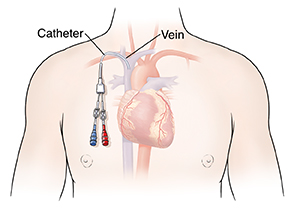
You need a central line as part of your treatment. It’s also called a central venous access device or central venous catheter. A small, soft tube called a catheter is put into a large vein that leads to your heart. When you no longer need the central line, it will be taken out. Your skin will then heal. This sheet describes types of central lines. It also explains how the central line is placed in your body.
What a central line does
A central line is often used instead of a standard I.V. (intravenous) line when you need treatment for longer than a week or so. It can also be inserted because some medicines cannot be safely put into smaller veins in the hand or arm. The line can deliver medicine, fluids, or nutrition right into your bloodstream. It can also be used to measure blood flow (hemodynamic monitoring), to draw blood, or for other reasons. Ask your health care provider why you need the central line and which type you’ll get.
Types of central lines
The central line will be placed into 1 of the veins as described below. Which vein is used depends on your needs and overall health. The catheter is threaded through the vein. It is passed along until the tip sits in the large vein near the heart (vena cava). Types of central lines include:
-
Peripherally inserted central catheter. This line is placed in a large vein in the upper arm, or near the bend of the elbow.
-
Subclavian line. This line is placed into the vein that runs behind the collarbone.
-
Internal jugular line. This line is placed into a large vein in the neck.
-
Femoral line. This line is placed in a large vein in the groin.
Placing the central line
The central line is placed in your body during a short procedure. This may be done in your hospital room, the emergency department, or an operating room. Your care team can tell you what to expect. During central line placement:
-
You’re fully covered with a large sterile sheet. Only the spot where the line will be placed is exposed. The skin is cleaned with antiseptic solution. These steps lower the risk for infection.
-
Medicine (local anesthetic) is injected near the vein. This numbs the skin so you don’t feel pain during the procedure.
-
After the pain medicine starts to work, the catheter is gently passed into the vein. It’s moved forward until the tip of the catheter is in the vena cava, close to the heart. This is usually done with the help of an ultrasound machine. The ultrasound machine helps see below the skin. It helps the provider guide the catheter into the vein without hurting other tissues or organs.
-
The other end of the catheter extends a few inches out from your skin. It may be loosely attached to the skin with stitches to hold it in place.
-
The health care provider flushes the catheter with saline solution to clear it. The solution may include heparin. This prevents blood clots.
-
An X-ray or other imaging test is done. This allows the provider to confirm the catheter’s position and check for problems.
Risks and possible complications
As with any procedure, having a central line placed has certain risks. These include:
-
Infection.
-
Bleeding problem. This tends to occur more often if an artery is punctured instead of a vein. But it can happen from puncture of a vein as well.
-
An irregular heartbeat.
-
Injury to the vein or to lymph ducts near the vein.
-
Inflammation of the vein (phlebitis).
-
Air bubble in the blood (air embolism). An air embolism can travel through the blood vessels and block blood flow to the heart, lungs, brain, or other organs.
-
Blood clot (thrombus) that can block the flow of blood. A blood clot can also travel through the blood vessels. It can block blood flow to the heart, lungs (pulmonary embolism), brain, or other organs.
-
Collapsed lung (pneumothorax) or blood buildup between the lungs and the chest wall (hemothorax).
-
Nerve injury.
-
Accidental insertion into an artery instead of a vein.
-
Catheter not positioned correctly.
If you have any problems with your central line, talk with your health care provider.
Removal
When your treatment is complete, the line can be safely removed. The health care provider will clean the area where the line was inserted. The provider will cut any stitches holding the line to the skin and then slowly pull the line out until the entire line is removed from your body. The provider will put pressure over the removal site for a minute or longer and then likely place a bandage on it. The provider will inspect the line to make sure it is intact and, depending on the type of line, may measure it.
Online Medical Reviewer: Amy Finke RN BSN
Online Medical Reviewer: Eric Perez MD
Online Medical Reviewer: Marianne Fraser MSN RN
Date Last Reviewed: 01/01/2025
© 2000-2026 The StayWell Company, LLC. All rights reserved. This information is not intended as a substitute for professional medical care. Always follow your healthcare professional's instructions.