Your child has been diagnosed with Guillain-Barré syndrome (GBS). This is an illness that affects the peripheral nerves, often both the sensory and motor nerves. Less often, it affects only the motor or only the sensory nerves. Motor and sensory nerves are located all over the body. Their job is to carry messages of movement and feeling to and from the brain and spinal cord to the rest of the body. With GBS, your child may feel weak and achy. Your child’s face, chest, or legs may be numb, weak, or even have no movement at all (paralyzed). GBS can cause serious health problems. But the illness is often short-term (temporary). Most children recover fully.
What are the risk factors for GBS?
GBS is an autoimmune disorder, meaning the body mistakenly attacks part of the peripheral nervous system. It seems to happen more often in children who have had recent infections, such as a virus or a cold. In very rare cases, GBS can happen after your child has had certain vaccines. The cause of GBS is unknown.
What are the symptoms of GBS?
With GBS, your child may have muscle aches or weakness that starts with the legs and spreads up the body. There may be trouble walking with tingling in the hands and feet. Symptoms can also include paralysis or trouble swallowing or breathing, which are an emergency. The problem can get worse quickly. So, it's important to get medical care at the first signs.
How is GBS diagnosed?
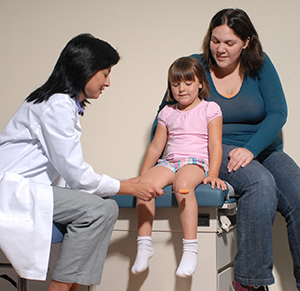
Your child will likely see a pediatric neurologist for diagnosis and treatment. This is a healthcare provider who specializes in nervous system problems in children. The provider examines your child. They also ask about your child’s health history and symptoms. The following may also be done:
-
Nervous system exam. This is done to check how well your child’s nervous system is working. During the exam, the healthcare provider checks your child’s muscle strength, balance, coordination, and reflexes. They also check skills such as memory, vision, hearing, talking, and swallowing.
-
Spinal tap (lumbar puncture). This checks the health of the fluid around the brain and spinal cord. This fluid is called cerebrospinal fluid. During the test, the low back is numbed. Then, a needle is inserted and a sample of the fluid is taken from the spinal canal. The fluid is checked in a lab for signs of infection and inflammation.
-
Nerve conduction study (NCS) and electromyogram (EMG). These tests check nerve and muscle function. NCS is often done first. During NCS, round discs attached to wires (electrodes) are placed on the skin along the pathways of certain nerves. The electrodes record how quickly the muscles and nerves respond to an electrical stimulus. During an EMG, small needle electrodes are placed in different muscles in the arms or legs. The electrical activity of the muscles is recorded as your child tightens and rests the muscles.
-
Blood tests. These may be done to check for signs of infection.
-
Imaging. Sometimes MRI or CT is needed to rule out other conditions. MRI can sometimes show inflammation of the nerve roots.
-
Pulmonary function tests. These are done to measure the strength of breathing muscles.
It is important to know that often in the early stages of GBS, test results are normal. A diagnosis in the early stage is mainly based on a child’s history and a physical exam.
How is GBS treated?
-
There is no cure for GBS. GBS may go away on its own in a few weeks. But treatment can help shorten the length of the illness.
-
If your child receives treatment, hospital care is needed until symptoms improve.
-
Procedures may be done. These include plasmapheresis or high-dose intravenous immune globulin (IVIg). Plasmapheresis cleans the blood of certain proteins. IVIg uses specialized blood products to help the body fight the abnormal immune reaction.
-
Your child may also receive supportive care to treat symptoms as needed. This can include medicine to treat muscle and nerve pain. Or it can be help with eating or breathing.
-
Overall treatment time will vary for each child. The healthcare provider will discuss other treatment choices with you if needed.
What are the long-term concerns?
Most children recover from GBS with no lasting problems. The recovery period may last as little as a few weeks. Or it may be as long as a few years. And nearly 1 in 3 of these children may still have some symptoms after they recover. About 3% of children may have symptoms return many years after the illness first started.