Management

For Kids: Avoiding Your Asthma Triggers

Choose a preferred language

You like to stay busy and have fun. But you may be afraid asthma will slow you down. Do your best to control your asthma. Then you can do all the things you like to do!

Draw a line from each problem on the left to the best answer on the right.
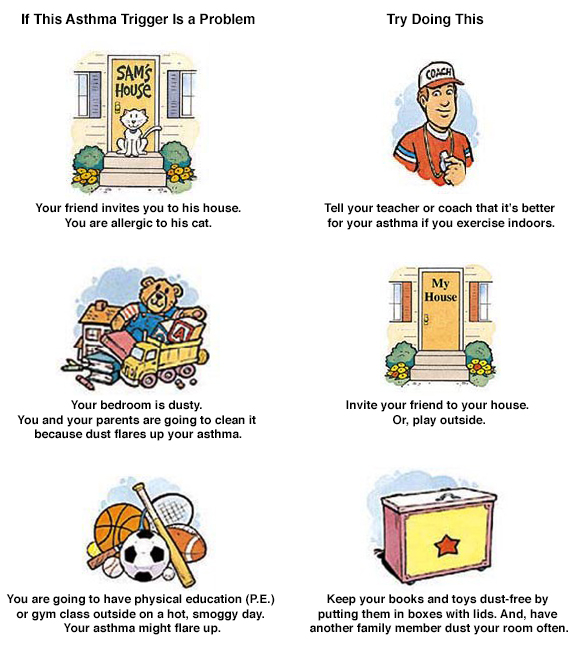
Composite image of a cat in front of a house, a coach with a whistle, a pile of toys, a front door to a house, sports equipment, and a toy chest.

Featured in

Online Medical Reviewer: Allen J Blaivas DO

Online Medical Reviewer: Amy Finke RN BSN

Online Medical Reviewer: Daphne Pierce-Smith RN MSN

Date Last Reviewed: 09/01/2024

© 2000-2026 The StayWell Company, LLC. All rights reserved. This information is not intended as a substitute for professional medical care. Always follow your healthcare professional's instructions.



Start your journey toward better health

Select a primary care physician who will deliver personal care, close to home.

Find a Doctor

We have more than 4,500 specialty care physicians in our network

We have you covered from head (neurosurgery) to toe (podiatry.) And everything in-between!

Find a Doctor

Need Help?

Get the right care at the right time.

Learn More
Related Articles
Read article
Lung Health
Treating Asthma at School

It's important to tell your child's teachers and other school staff about your child's asthma. That way, they can help your child if symptoms get worse, or if your child has an asthma attack at school.

Read article
Infectious Diseases
Shigella Gastroenteritis (Child)

Shigella is an infection of the intestinal tract. It is caused by bacteria. It is more serious than the common stomach flu caused by a virus.

Read article
Infectious Diseases
Tonsillitis (Strep Throat)

An infection around the tonsils is generally caused by the streptococcus bacteria. The infection can cause severe sore throat, pain with swallowing, swollen glands, and fever.

Read article
Dental Care
Dental Trauma (Child)

A blow to the mouth can cause damage to the teeth. This is called dental trauma. Learn how to help your child recover at home.