What are standard evaluation procedures?
Before your child’s health care provider can recommend treatment or rehabilitation, they must first find out the reason for, and source of, your child's condition. This typically means doing a full physical exam and taking a detailed health history. Tell your child's provider about any other illnesses, injuries, or complaints that have been linked to the pain or condition. Also tell the provider about any past treatments or medicines prescribed. Some early tests may then be done, including:
-
Blood tests
-
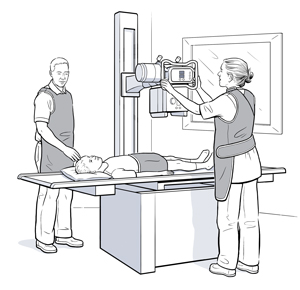
X-rays. A diagnostic test that uses electromagnetic energy to make images of internal tissues, bones, and organs onto film.
Advanced evaluation procedures
Children who need further evaluation may have one or more of the following:
-
MRI. This is a diagnostic procedure. It uses a combination of large magnets, radiofrequencies, and a computer to make detailed images of organs and structures in the body.
-
CT scan. This is a diagnostic imaging test. It uses a combination of X-rays and computer technology to make horizontal (axial) images of the body. A CT scan shows detailed images of any part of the body. This includes the bones, muscles, fat, and organs. CT scans are more detailed than general X-rays.
-
EMG (electromyogram). This test assesses nerve and muscle function.
-
Bone scan. This is a nuclear imaging test. It evaluates any degenerative or arthritic changes in the joints. It can also find bone diseases and tumors. And it can help find the cause of bone inflammation.
-
Ultrasound. This is becoming a common test for evaluating musculoskeletal complaints. It uses sound waves to form images of the body.
After reviewing the test results, your child's orthopedist will discuss all treatment choices with you. The health care provider will help you select the best treatment plan to help your child live an active and functional life.
Featured in
Date Last Reviewed: 03/01/2025
© 2000-2026 The StayWell Company, LLC. All rights reserved. This information is not intended as a substitute for professional medical care. Always follow your healthcare professional's instructions.