Treatment

Hip Arthroscopy: Repairing Chondral Damage

Choose a preferred language


When the firm, smooth tissue that covers the ball and socket of the hip is damaged, it can cause painful catching in the joint. This tissue is called cartilage. Injury to cartilage is called chondral damage. Arthroscopy is a surgery method that uses only small incisions and small tools. It can be done to fix chondral damage.


In the operating room

Just before surgery, you may be asked several times which hip is to be treated. This is a standard safety measure in the operating room. You will likely receive medicine (anesthesia) to make you sleep.


During the procedure

After you receive anesthesia, your leg is gently pulled to widen the hip joint. Next, the surgeon makes a few small incisions called portals. Through these portals, they insert surgical tools, including the arthroscope. The arthroscope sends images of the joint to a screen. These images allow the surgeon to look inside the joint. The joint is filled with sterile fluid to help the surgeon see more clearly.
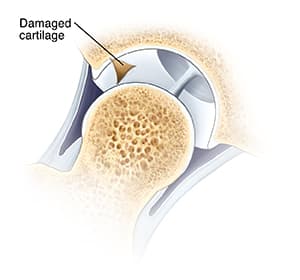
Cross section of hip joint with femoral head moved out of socket, showing damaged cartilage lining of socket.


Repairing chondral damage

If the damaged cartilage is loose, it is removed. If the cartilage is missing, the exposed bone may be shaved to smooth it. Or small holes may be placed in the bone (microfracture). This allows new cartilage to form. Once the surgeon finishes, the portals are closed and bandaged. Then you are taken to the recovery room.
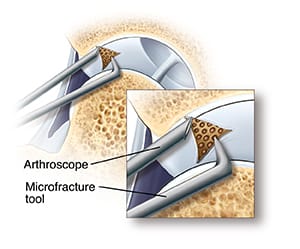
Hip joint with femoral head moved out of socket and arthroscope near damaged cartilage, showing microfracture tool creating small holes in bone.

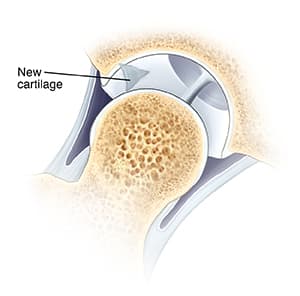
Hip joint with femoral head moved out of socket, showing new cartilage that formed over area where small holes were placed.

Online Medical Reviewer: L Renee Watson MSN RN

Online Medical Reviewer: Raymond Turley Jr PA-C

Online Medical Reviewer: Thomas N Joseph MD

Date Last Reviewed: 09/01/2025

© 2000-2026 The StayWell Company, LLC. All rights reserved. This information is not intended as a substitute for professional medical care. Always follow your healthcare professional's instructions.



Start your journey toward better health

Select a primary care physician who will deliver personal care, close to home.

Find a Doctor

We have more than 4,500 specialty care physicians in our network

We have you covered from head (neurosurgery) to toe (podiatry.) And everything in-between!

Find a Doctor

Need Help?

Get the right care at the right time.

Learn More
Related Articles
Read article
Orthopedics
Treating Ankle Fractures

Treatment depends on where and how badly your ankle has been broken. A cast may be used to hold the bone in position for healing.

Read article
Orthopedics
Foot Surgery: Flexible and Rigid Hammertoes

With hammertoes, one or more toes curl or bend abnormally. This can be caused by an inherited muscle problem, an abnormal bone length, or poor foot mechanics. There are many nonsurgical treatments for hammertoes, but if these are not effective, you may want to consider surgery.

Read article
Orthopedics
Patella (Kneecap) Dislocation or Subluxation, Reduced

The kneecap is held in place by ligaments and tendons. If the kneecap is hit with a strong force, it can slide too far to the side of the knee joint, tearing these ligaments and tendons. This sliding is called subluxation or dislocation.

Read article
Orthopedics
Microdiskectomy

During a microdiscectomy, some disk is removed. In most cases, bone must first be removed to expose the damaged disk. The part of the disk outer wall and soft center that presses on the nerve can then be removed. There is usually enough disk remaining to cushion the vertebrae.