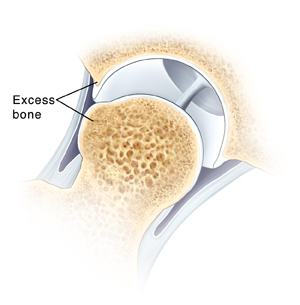
When excess bone has formed on the edge of the ball (femoral head) or the socket (acetabulum) of the hip, it's called femoroacetabular impingement (FAI). FAI can cause pain and limit movement. Arthroscopy can fix FAI with only small incisions and special tools.
In the operating room
Just before surgery, you may be asked several times which hip is to be treated. This is a standard safety measure. In the operating room, you will likely receive general anesthesia to make you sleep.
During the procedure
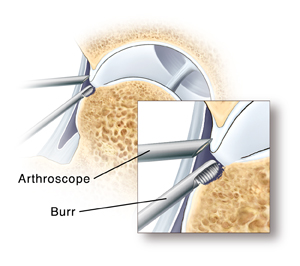
After you receive anesthesia, your leg is gently pulled to distract, or widen, the hip joint. Next, the surgeon makes a few small incisions. These are called portals. The surgeon puts surgical tools, including the arthroscope, through these portals. The arthroscope sends images of the joint to a video screen. These images let the surgeon see inside the joint. The joint is filled with sterile fluid to help the surgeon see more clearly.
Treating FAI
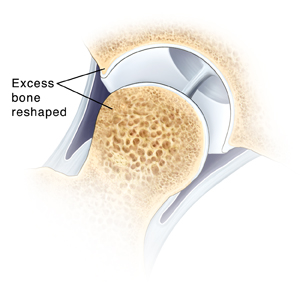
To treat FAI, the area is reshaped by taking out excess bone. Excess bone can be taken from the socket side or ball side of the hip joint, or both. FAI can lead to cartilage problems, such as labral tears or chondral damage. If present, these problems are also treated. Once the surgeon is done, they close and bandage the portals. Then you are taken to the recovery room.
Online Medical Reviewer: Rahul Banerjee MD
Online Medical Reviewer: Stacey Wojcik MBA BSN RN
Date Last Reviewed: 03/01/2025
© 2000-2026 The StayWell Company, LLC. All rights reserved. This information is not intended as a substitute for professional medical care. Always follow your healthcare professional's instructions.