Treatment

Hip Arthroscopy: Repairing Synovitis and Arthritis

Choose a preferred language

Synovitis of the hip causes the lining of the joint (synovium) to become inflamed, painful, and swollen. With arthritis, a large amount of the firm, smooth tissue covering the “ball” and “socket” of the hip (cartilage) is damaged. Using only small incisions and special tools, arthroscopy can help fix synovitis and arthritis.
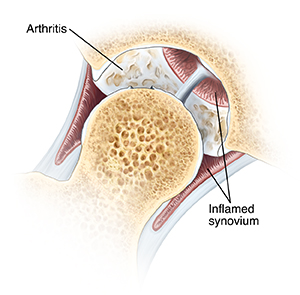
Cross section of hip joint with femoral head moved out of socket. Cartilage lining socket is damaged. Synovium lining joint is inflamed.


In the operating room

Just before surgery, you may be asked several times which hip is to be treated. This is a standard safety measure. In the operating room, you will likely receive medicine (anesthesia) to make you sleep or numb the area.


During the procedure

After you receive anesthesia, your leg is gently pulled to widen the hip joint. Next, the surgeon makes a few small incisions called portals. Through these portals, the surgeon inserts surgical tools, including the arthroscope. The arthroscope sends images of the joint to a screen. These images allow the surgeon to look inside the joint. The joint is filled with sterile fluid to help the surgeon see more clearly.


Repairing synovitis and arthritis

For synovitis, part of the damaged synovium is removed. This may be done by shaving tissue using special tools. For arthritis, the loose or torn cartilage is removed. Or it may be smoothed with a shaver. Arthritis can lead to bone spurs. If bone spurs are present, they may be removed. Once the surgeon finishes, the portals are closed and bandaged. Then you are taken to the recovery room.
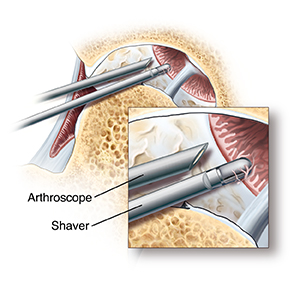
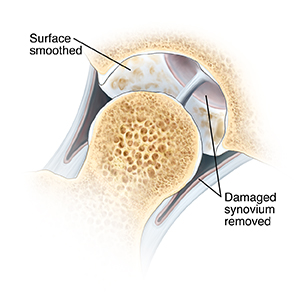
Cross section of hip joint with femoral head moved out of socket. Cartilage lining socket is damaged. Synovium lining joint is inflamed. Arthroscopic instruments are in joint near top of socket. Closeup of arthroscope tip inside joint with shaver removing damaged synovium.Cross section of hip joint with femoral head moved out of socket. Cartilage lining socket is smoothed. Damaged synovium is removed.

Online Medical Reviewer: L Renee Watson MSN RN

Online Medical Reviewer: Raymond Turley Jr PA-C

Online Medical Reviewer: Thomas N Joseph MD

Date Last Reviewed: 07/01/2023

© 2000-2026 The StayWell Company, LLC. All rights reserved. This information is not intended as a substitute for professional medical care. Always follow your healthcare professional's instructions.



Start your journey toward better health

Select a primary care physician who will deliver personal care, close to home.

Find a Doctor

We have more than 4,500 specialty care physicians in our network

We have you covered from head (neurosurgery) to toe (podiatry.) And everything in-between!

Find a Doctor

Need Help?

Get the right care at the right time.

Learn More
Related Articles
Read article
Orthopedics
Hip Arthroscopy: Labral Tears

Arthroscopy can be used to repair tears in the strong, flexible ring of cartilage attached to the edge of the hip socket, called the labrum.

Read article
Orthopedics
Splints and Casts

Splints and casts are used to help support and protect a variety of bone and soft tissue injuries. They keep an injured area from moving.

Read article
Orthopedics
Achilles Tendon Repair Surgery

Achilles tendon repair surgery is a type of surgery to fix a damaged Achilles tendon. Learn more about the surgery, including why you might need it, what the risks are, how to get ready for it, and what happens during and after the surgery.

Read article
Orthopedics
Femur Fracture Open Reduction and Internal Fixation

Open reduction and internal fixation (ORIF) is a type of surgery used to stabilize and heal a broken bone. You might need this procedure to treat your broken femur. Read on to learn what to expect before, during, and after this surgery.