Dupuytren contracture may need no treatment if your symptoms are mild. You may need treatment if your symptoms are more severe or they get worse. Steroid or enzyme injections can be done to weaken and disrupt the cords. Another choice is surgery. Surgery may be done to remove the affected tissue. You may need physical therapy afterward to get the best results. Recovery may take several months. Your healthcare provider may suggest surgery if use of your hand is sharply limited.
Your surgery experience
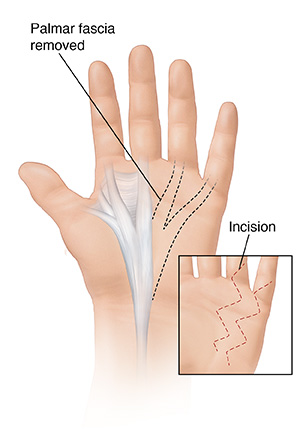
Surgery removes some of the palmar fascia. This can take a few hours. You may be awake but drowsy during surgery. Or you may have general anesthesia. This lets you sleep during the surgery. Your healthcare provider may use a zigzag-shaped incision to reach the fascia. A zigzag allows better healing and finger motion. When surgery is complete, part of your incision may be left open to help drainage. It will close on its own as you heal. A thick bandage or cast will be placed over your hand and forearm. You most likely will go home the day of surgery.
After surgery
Keep your hand elevated above your heart to reduce swelling and pain in the first few days. And take any pain pills your healthcare provider prescribed. Follow your healthcare provider’s advice if you're asked to use ice. Your stitches will be removed in about a week or two. You then may need to wear a splint. Soon you’ll start hand therapy and exercises that can help you heal.
Risks and possible complications
Your healthcare provider will give you details about the possible risks and complications of surgery. These may include:
-
Stiff fingers
-
Thick scarring on palm
-
Numbness in hand
-
Swelling around finger joints
-
Impaired blood flow to hand
-
Long-term pain or permanent stiffness in hand (rare)
-
Infection
Online Medical Reviewer: Rahul Banerjee MD
Online Medical Reviewer: Raymond Turley Jr PA-C
Online Medical Reviewer: Stacey Wojcik MBA BSN RN
Date Last Reviewed: 09/01/2025
© 2000-2026 The StayWell Company, LLC. All rights reserved. This information is not intended as a substitute for professional medical care. Always follow your healthcare professional's instructions.