Treatment

Understanding Knee Replacement

Choose a preferred language


The knee is a joint that works like a hinge. It is formed where the thighbone (femur), shinbone (tibia), and kneecap (patella) meet. It is supported by muscles, tendons, and ligaments. It is also lined with cushioning cartilage. Over time, cartilage can wear away. As it does, the knee becomes stiff and painful. An artificial knee joint (prosthesis) can replace the painful joint and restore movement.


A healthy knee

A healthy knee joint bends easily. Cartilage is a smooth tissue. It covers the ends of the thighbone and shinbone and the underside of the kneecap. Healthy cartilage absorbs stress and allows the bones to glide freely over each other. Joint fluid lubricates the cartilage surfaces, making movement even easier.
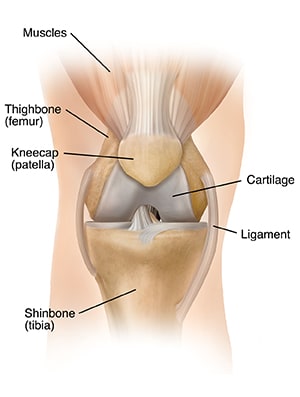
Healthy knee joint, showing muscles, thighbone, kneecap, cartilage, ligament, and shinbone.


A problem knee

A problem knee is often stiff and painful. Cartilage cracks or wears away due to usage, inflammation, or injury. Worn, roughened cartilage no longer lets the joint glide freely. So it feels stiff and painful. As more cartilage wears away, exposed bones rub together when the knee bends, causing pain. With time, bone surfaces also become rough, making pain worse.
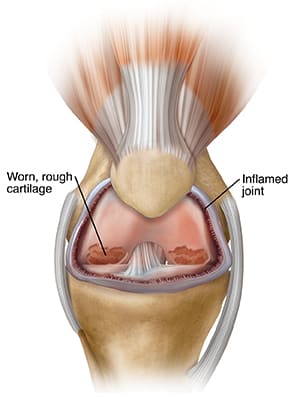
Knee with problems, showing worn, rough cartilage and inflamed joint.


A knee prosthesis

A knee prosthesis lets your knee bend easily again. The roughened ends of the thighbone and shinbone and the underside of the kneecap are replaced with metal and strong plastic parts. With new smooth surfaces, the bones can once again glide freely without pain. A knee prosthesis does have limits. But it can let you walk and move with greater comfort.
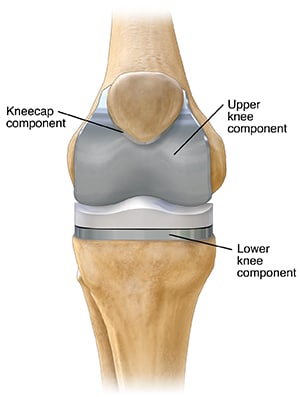

Knee after replacement with full knee prothesis, including kneecap, upper knee and lower knee components.

© 2000-2026 The StayWell Company, LLC. All rights reserved. This information is not intended as a substitute for professional medical care. Always follow your healthcare professional's instructions.

Start your journey toward better health

Select a primary care physician who will deliver personal care, close to home.

Find a Doctor

We have more than 4,500 specialty care physicians in our network

We have you covered from head (neurosurgery) to toe (podiatry.) And everything in-between!

Find a Doctor

Need Help?

Get the right care at the right time.

Learn More
Related Articles
Read article
Orthopedics
Treating Ankle Fractures

Treatment depends on where and how badly your ankle has been broken. A cast may be used to hold the bone in position for healing.

Read article
Orthopedics
Before Arthroscopy

Here's what to know before you have arthroscopy.

Read article
Orthopedics
Treating Charcot Foot

If you have Charcot foot, you will need to stay off your foot until it heals.

Read article
Orthopedics
Foot Surgery: Curled Fifth Toe

A curled fifth toe is most often inherited. When the fifth toe curls inward, it moves under the next toe. Then the nail of the curled toe starts to face outward. As a result, you may bear weight on the side of your toe instead of the bottom. This can cause corns and painful nails. There are many nonsurgical treatments available. But if these are not effective, surgery is a choice.