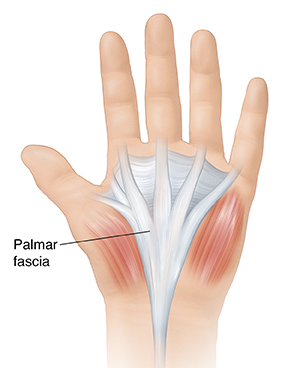
Dupuytren contracture is a disease that occurs when the fibrous tissue beneath the skin of the palm and fingers thickens. This tissue is called the palmar fascia. If the disease gets worse, it can cause small hard knots (nodules) to form under the skin. Hard bands (cords) of tissue can also form. Over time, your fingers may curl and bend toward the palm. This effect is called contracture. This can make it hard to straighten your fingers.
How to say it
doo-pweh-TRAHN kahn-TRAK-cher
What causes Dupuytren contracture?
Doctors don’t know the exact cause of Dupuytren contracture. It may run in families, especially those of Northern European descent. The disease is more common in adults older than 50. It's also more common in men than in women.
Symptoms of Dupuytren contracture
Symptoms for Dupuytren contracture tend to develop slowly. They may include:
-
Pitted, dimpled, or puckered skin over the palm
-
Hard lumps that form on the palm. Sometimes the lumps are sore at first.
-
Scar-like bands that form across the palm
-
Fingers that bend toward the palm. The ring and little fingers are most often affected.
-
You can't place your palm flat on a surface
-
You have trouble holding or grasping objects
-
Hand pain (less common)
Treating Dupuytren contracture
Treatment for Dupuytren contracture depends on how serious your symptoms are. Treatment can’t cure the disease. But it can help reduce symptoms or make it easier to move your fingers. Treatments may include:
-
Medicine shots (injections). These often are anti-inflammatory medicines called corticosteroids. These shots may help ease symptoms and reduce the size of nodules.
-
Enzyme shots. These may be used to break up the thickened tissue. This helps reduce contracture. It may allow your fingers to straighten again.
-
Needle aponeurotomy. Shallow needle punctures are made through the skin to break up the thickened issue. This helps reduce contracture. It may allow your fingers to straighten again.
-
Hand exercises. These are often prescribed along with other treatments. They may help stretch and improve the range of motion in the hand and fingers.
-
Surgery. Many surgical techniques may be used to remove some of the thickened tissue in the palm. This helps reduce contracture. It also improves normal finger motion and hand function.
Possible complications of Dupuytren contracture
In some people, the contracture in the hand may get worse over time. This can lead to joint stiffness, deformity, and reduced function of the hand.
When to call your healthcare provider
Call your healthcare provider right away if you have any of these:
-
Fever of 100.4°F (38°C) or higher, or as directed by your provider
-
Chills
-
Symptoms that don’t get better with treatment, or that get worse
-
New symptoms
Author: Yang, Sue
Online Medical Reviewer: Kenny Turley PA-C
Online Medical Reviewer: L Renee Watson MSN RN
Online Medical Reviewer: Raymond Kent Turley BSN MSN RN
Date Last Reviewed: 04/01/2024
© 2000-2026 The StayWell Company, LLC. All rights reserved. This information is not intended as a substitute for professional medical care. Always follow your healthcare professional's instructions.