A Lisfranc joint injury is a kind of injury to the bones or ligaments in the middle of the foot. It is also called a midfoot joint injury. There is often also damage to the cartilage that covers these bones. The Lisfranc joint injury gets its name from a French surgeon.
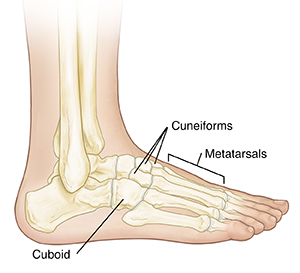
Parts of the arch of the foot
In the middle part of your foot, a group of 10 small bones forms an arch. Five of these long bones (metatarsals) lead to your toes. The group also includes the cuboid bone and the medial, middle, and lateral cuneiform bones. Tight connective tissue bands hold all of these bones in place and give the joint its stability. This area of your foot is important to keep your arch steady. It also moves the force from your calves to the front of your feet when you walk.
What causes a Lisfranc (midfoot) joint injury?
A twisting fall may break 1 or more of these bones or move them out of place. This causes a Lisfranc injury. It’s also called a tarsometatarsal joint injury. There are different types of Lisfranc injuries. They depend on the direction of the shifted metatarsals and how badly they are shifted.
A Lisfranc joint injury may be the result of twisting and falling on a foot that is pointing down. This is common in football and soccer players. Lisfranc injuries can also happen from a car accident.
What are the symptoms of a Lisfranc (midfoot) joint injury?
A Lisfranc joint injury can cause symptoms, such as:
-
Pain in your midfoot.
-
Pain to the touch.
-
Swelling or deformity in the middle part of your foot.
-
Inability to put weight on your foot.
-
Bruising in the middle of your foot, top and bottom. Bruising at the bottom part of your foot suggests a Lisfranc injury.
How is a Lisfranc (midfoot) joint injury diagnosed?
It's important to have a Lisfranc joint injury diagnosed correctly. It has many of the same symptoms as an ankle sprain. But the treatment for an ankle sprain is very different. Your doctor will ask about your health history. They will ask questions about your symptoms and recent accidents. They will also check your foot, looking for pain, deformity, bruising, and swelling. Your doctor may hold your toes and move them up and down to see if this causes pain.
You will likely have X-rays. The X-rays will be done at special angle, so they can show the injury. A Lisfranc joint injury may not show up on standard X-rays.
You may also need other imaging tests of your foot. These tests may show a Lisfranc joint injury that an X-ray may not. You may have tests, such as:
-
MRI scan. This uses strong magnets and a computer to make images of the body. It gives more information about damage to the soft tissues in your foot.
-
CT scan. This uses a series of X-rays and a computer to make detailed images. A special kind of imaging dye may be used. The scan gives information about damage to your bones.
Online Medical Reviewer: Rahul Banerjee MD
Online Medical Reviewer: Raymond Turley Jr PA-C
Online Medical Reviewer: Stacey Wojcik MBA BSN RN
Date Last Reviewed: 04/01/2025
© 2000-2026 The StayWell Company, LLC. All rights reserved. This information is not intended as a substitute for professional medical care. Always follow your healthcare professional's instructions.