A bursa is a thin, slippery, sac-like film. It contains a small amount of fluid. This structure is found between bones and soft tissues in and around joints. A bursa cushions and protects a joint. It keeps parts of a joint from rubbing against each other.
The prepatellar bursa is found on top of the kneecap (patella). It lies just under the skin. If this bursa becomes irritated and inflamed, the condition is called prepatellar bursitis.
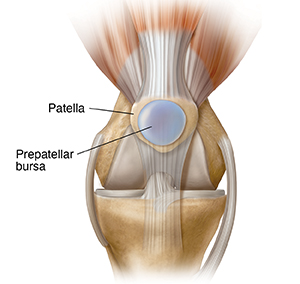
Causes of prepatellar bursitis
A common cause of this problem is repeated kneeling on the floor. For this reason, it is sometimes called housemaid’s knee. Workers such as plumbers, carpet layers, roofers, and gardeners are at risk. Injury from a blow to your kneecap can also cause it. Athletes in sports such as football and wrestling are at a greater risk. Running on uneven ground may also play a role. Other conditions such as rheumatoid arthritis and gout may also cause prepatellar bursitis.
Symptoms of prepatellar bursitis
These may include:
-
Knee pain that gets worse with bending or pressure to the knee and gets better with rest
-
Swelling over the kneecap
-
Soreness or warmth over the kneecap
-
Crackling sound from the kneecap with movement
Treatment for prepatellar bursitis
This problem often gets better with rest and medicines. Other treatments may be needed. Possible treatments include:
-
Resting your knee. This allows the area to heal. It includes not doing things that trigger symptoms.
-
Prescription or over-the-counter medicines. These help reduce pain and swelling. NSAIDs (nonsteroidal anti-inflammatory drugs) are the most common medicines used. Medicines may be prescribed or bought over the counter. They may be given as pills. Or they may be put on the skin as a gel, cream, or patch.
-
Stretching and strengthening exercises. These help improve the strength and flexibility of the muscles around the knee.
-
Cold packs or heat packs. These help reduce pain and swelling.
-
Physical therapy. This may include exercises, ultrasound, or other treatments.
-
Knee pads. These help protect your knees during sports.
-
Injection of medicine into the bursa or draining fluid from the bursa. These may help relieve symptoms. The medicine is usually a corticosteroid. This is a strong anti-inflammatory medicine.
For symptoms that don’t get better with these treatments, surgery to remove the bursa may help.
Possible complications
-
If germs get into the bursa through a cut in your skin, the bursa may become infected. An infection is generally treated with antibiotic medicine. In some cases, the infected bursa must be removed.
-
If your knee isn’t given time to heal, this problem may become long-term (chronic). This can lead to trouble moving the knee joint.
When to call your healthcare provider
Call your healthcare provider right away if you have any of these:
-
Fever of 100.4°F (38°C) or higher, or as advised by your provider
-
Chills
-
Increased swelling or warmth of the area
-
Fluid leaking from the area
-
Symptoms that don’t get better or get worse
-
New symptoms
Author: Michels, Karen
© 2000-2026 The StayWell Company, LLC. All rights reserved. This information is not intended as a substitute for professional medical care. Always follow your healthcare professional's instructions.