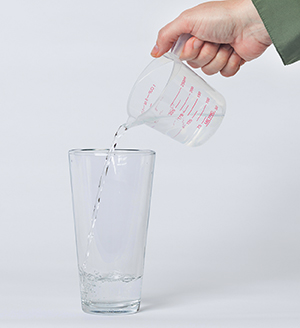
Healthy kidneys balance the amount of fluid that enters and leaves the body. If your kidneys can't maintain this fluid balance, you may need to limit your fluid intake. Always talk with your healthcare provider and ask how many ounces of fluid you can have every 24 hours. For accuracy, it's helpful to use a certain glass or mug and measure how much fluid it holds. Some glasses and mugs may look the same size. But they can hold different amounts of fluid. The information below can help.
What counts as a fluid?
Fluids are foods that are liquid at room temperature. Foods that count toward your fluid intake include:
-
Water for drinking and taking medicines.
-
Ice cubes and ice chips.
-
Coffee and tea.
-
Sodas.
-
Milk, cream, and liquid creamer.
-
Juices, both fruit and vegetable.
-
Soups.
-
Flavored ice pops.
-
Ice cream, sherbets, and sorbets.
-
Gelatin dessert, such as Jell-O.
Figuring fluid amounts
Fluids can be measured in different ways. The chart below can help you convert among units of measure. For ease of use, some numbers have been rounded off.
|
1 liter |
4.2 cups |
34 ounces |
1,000 ml |
|
1 quart |
4 cups |
32 ounces |
1,000 ml |
|
1 pint |
2 cups |
16 ounces |
500 ml |
|
1/2 pint |
1 cup |
8 ounces |
250 ml |
|
1/2 cup |
4 ounces |
120 ml |
|
|
1/3 cup |
3 ounces |
80 ml |
|
|
1/4 cup |
2 ounces |
60 ml |
|
|
2 tbsp |
1/8 cup |
1 ounce |
30 ml |
Online Medical Reviewer: Marianne Fraser MSN RN
Online Medical Reviewer: Raymond Kent Turley BSN MSN RN
Online Medical Reviewer: Walead Latif MD
Date Last Reviewed: 02/01/2025
© 2000-2026 The StayWell Company, LLC. All rights reserved. This information is not intended as a substitute for professional medical care. Always follow your healthcare professional's instructions.