Healthy Living

Ergonomics: Does Your Workstation Fit You?

Choose a preferred language

You may not know it, but working at your computer can take a toll on your body. It can cause sore muscles, headaches, eyestrain, tension, and fatigue. But ergonomics can help. It's the science of arranging your workstation to fit you and your body. Read on to find out how ergonomics can help solve problems you may be having.
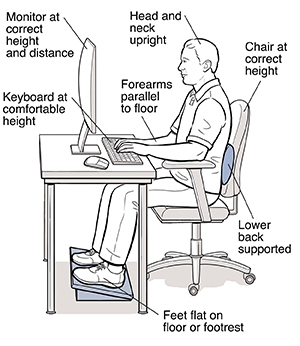
Side view of man sitting at ergonomically correct computer workstation.

If your eyes are really tired at the end of the day, adjusting your monitor or lighting may help.

If your neck and shoulders are often stiff and sore, your chair height, monitor, or keyboard may need adjusting.

If you ever feel pain or discomfort in your back while working at your computer, adjusting your backrest or sitting posture may take strain off your back.

If you feel tingling, numbness, or pain in your forearms, wrists, or hands, your chair height or keyboard may need adjusting.

If your body feels tired, achy, or stiff at the end of the day, you may need to take stretch breaks more often.

If your legs are often stiff and cramped, or you have swelling and numbness in your ankles and feet, your chair might not be at the best height for you. Or you may need a footrest.

Online Medical Reviewer: Raymond Kent Turley BSN MSN RN

Online Medical Reviewer: Rita Sather RN

Online Medical Reviewer: Thomas N Joseph MD

Date Last Reviewed: 10/01/2024

© 2000-2026 The StayWell Company, LLC. All rights reserved. This information is not intended as a substitute for professional medical care. Always follow your healthcare professional's instructions.



Start your journey toward better health

Select a primary care physician who will deliver personal care, close to home.

Find a Doctor

Need Help?

Get the right care at the right time.

Learn More
Related Articles
Read article
Wellness
Reducing Risk of Musculoskeletal Disorders: Posture at Your Workstation

Having correct posture reduces strain on soft tissues. When you're in neutral position, your bone structure supports you and provides a stable base to move from. To stay close to neutral, try these tips.

Read article
Wellness
Reducing Work-Related MSD Risk: Part of Your Health and Safety Program

Reducing the risk of job-related injuries, including MSDs (musculoskeletal disorders), is part of every health and safety program. By taking responsibility for your health and well-being, you help control any current symptoms and prevent future injury.

Read article
Wellness
Ergonomics and Musculoskeletal Disorders: Quiz

Take this short quiz to find out how much you know about ergonomics and musculoskeletal disorders (MSDs). Select the best answer for each question. Answers are at the bottom of the page.

Read article
Wellness
In Case of Emergency...Be Ready for Anything

Don't wait to think about disaster until you're dealing with one. In the hurried confusion, you're likely to miss important items as you prepare your home or leave to find shelter.