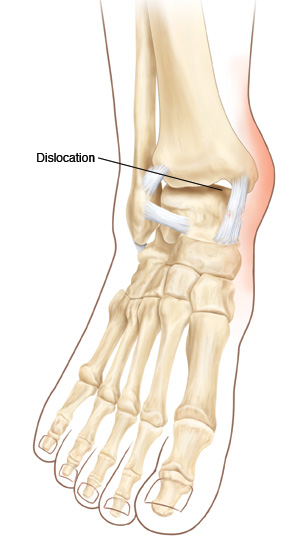
Ankle dislocation is when a strong force pushes your ankle bone out of place. To treat this, the bone is moved back into place. This is called reducing the dislocation.
Ankle dislocations cause pain and swelling. Sometimes the ankle gets discolored. The area will look deformed. Ankle dislocations often occur with sprains and sometimes with breaks or fractures.
A dislocation must be put back into place as soon as possible. A bone that is out of place for too long may cause long-lasting nerve, joint, or blood vessel damage. IV (intravenous) pain medicines are often given before a reduction. In most cases, bones go back into place easily. In more severe cases, surgery may be needed to realign the joint and repair torn ligaments or broken bones.
Once the joint is put back into place, it will take about 6 to 8 weeks for the ligaments and bones to heal. Range of motion exercises or physical therapy may be prescribed early in your recovery. This is to prevent the joint from getting stiff. Later, strengthening exercises may be added.
After a dislocation, your joint may not regain full range of motion or heal fully. You're also at risk of getting arthritis in that joint. You'll likely be sent to an orthopedic or bone health care provider for evaluation and follow-up.
Based on how severe your injury is, your ankle will be held in place with a stabilizer. This limits joint motion so your ankle can heal. The provider will decide which type of stabilizer to use. It may be a cast, bandage, splint, or boot.
You may also be given crutches to keep weight off your injured ankle.
Home care
-
Keep your leg raised to reduce pain and swelling. When sleeping, place a pillow under the injured leg. When sitting, keep your leg above the level of your heart. This is very important during the first 48 hours.
-
Follow your provider’s advice about when to begin bearing weight on your injured leg.
-
Place an ice pack over the injured area for no more than 20 minutes. Do this every 3 to 6 hours for the first 24 to 48 hours. Keep using ice packs 3 to 4 times a day for the next 2 days. Then use as needed to ease pain and swelling.
-
To make an ice pack, put ice cubes in a plastic bag that seals at the top. Wrap the bag in a clean, thin towel or cloth. Never put ice or an ice pack directly on your skin. You can place the ice pack directly over the cast, bandage, or splint. As the ice melts, be careful that the cast, bandage, or splint doesn’t get wet.
-
If you have a boot, open it to apply an ice pack, unless told otherwise by your provider. Wrap the ice pack in a clean, thin towel or cloth. Never put ice or an ice pack directly on your skin.
-
Keep the cast, bandage, splint, or boot dry. When bathing, protect it with 2 large plastic bags. Place 1 bag around the other. Tape each bag with duct tape at the top end or use rubber bands. Water can still leak in even when your foot is covered. So it's best to keep the cast, bandage, splint, or boot away from water. If a fiberglass splint or cast becomes wet, you can dry it with a hair dryer on a cool setting. A vacuum cleaner with a hose attachment can also be used to pull air through the cast for speed drying.
-
Remove the plastic bags and duct tape or rubber bands right away after bathing.
-
You may use over-the-counter pain medicine to control pain, unless another pain medicine was prescribed. Nonsteroidal anti-inflammatory drugs (NSAIDs) like ibuprofen or naproxen may work better than acetaminophen.
Talk with your provider before using these medicines if you have chronic liver or kidney disease, have ever had a stomach ulcer or GI (gastrointestinal) bleeding, or take blood thinners.
Follow-up care
Follow up with your health care provider within 1 week, or as advised.
If X-rays were taken, you'll be told of any new findings that may affect your care.
When to get medical advice
Call your health care provider right away if any of these occur:
-
The cast has a bad smell.
-
The cast has cracks or breaks.
-
The plaster cast or splint becomes wet or soft.
-
The fiberglass cast or splint stays wet for more than 24 hours.
-
The splint or cast is too tight or too loose.
-
The injured foot has more swelling or severe pain.
-
You feel increased tightness or pain under the cast or splint.
-
The toes on the foot of your injured leg are cold, blue, numb, or tingly.
-
The injury doesn’t seem to be healing.
-
You can't move your toes on the foot of your injured leg.
-
The skin looks blue, purple, or gray (discolored), or has blisters or is irritated.
Online Medical Reviewer: L Renee Watson MSN RN
Online Medical Reviewer: Raymond Turley Jr PA-C
Online Medical Reviewer: Thomas N Joseph MD
Date Last Reviewed: 12/01/2024
© 2000-2026 The StayWell Company, LLC. All rights reserved. This information is not intended as a substitute for professional medical care. Always follow your healthcare professional's instructions.